


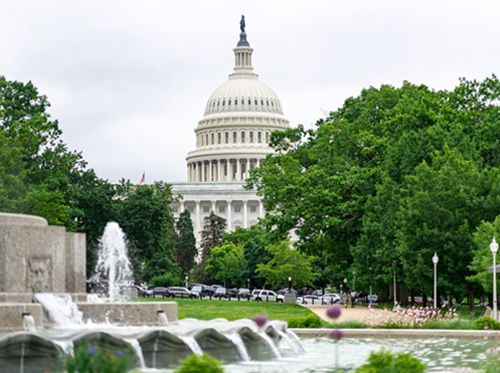
On August 2, the U.S. Senate released the text of a Continuing Resolution or CR that would keep the federal government funded through mid-December. That CR also includes an extension of surface transportation program authorities.
[Above photo by the Architect of the Capitol]
Several procedural steps are required before a final vote can be taken on the Senate’s funding measure. The Senate passed a motion to invoke cloture and advance the legislation to proceed earlier this week by a vote of 89 to 4. A final vote on the funding bill is expected to happen before the Senate adjourns for its traditional August recess on August 7.
According to analysis by the American Association of State Highway and Transportation Officials, the Senate’s CR funds the federal government through December 11 while a similar CR measure passed by the House of Representatives on July 21 before its August recess only provides funding through December 4 – one of several issues between the two measures that must be reconciled and voted on.
The Senate’s Continuing Resolution Act provides pro-rated obligation limitation and fiscal year 2027 appropriations and extends the availability of FY 2023 Highway Infrastructure Program unobligated balances for another fiscal year. Thus, instead of these balances expiring on September 30 of this year, they will be available until September 30, 2027.
The CR also extends the ability to liquidate certain Federal Transit Administration Capital Investment Grant obligations. It also precludes the Office of Management and Budget from finalizing its proposed changes to Uniform Administrative Requirements, Cost Principles, and Audit Requirements for Federal Awards through at least December 11. (AASHTO’s comments on those proposed changes can be viewed here.)
The Senate’s CR also includes language regarding an extension of federal surface transportation funding, something a similar CR passed by the House does not.
In the Senate CR, the Surface Transportation Extension Act extends the Infrastructure Investment and Jobs Act or IIJA’s surface transportation authorities, eligibilities, and requirements through December 11, providing pro-rated contract authority for highway and transit programs, AASHTO noted.
It also prevents a “lapsing” of funding on September 30 – the end of FY 2026 – of unobligated Highway Trust Fund (HTF) contract authority for certain allocated discretionary grant programs by extending the availability of this contract authority through September 30, 2027. This would apply to discretionary grant programs, not formula programs, funded by the HTF, such as the Bridge Investment Program, Nationally Significant Multimodal Freight & Highway Projects or “INFRA” grants, Rural Surface Transportation grants, and the Wildlife Crossing Pilot program.
AASHTO also noted that the Senate CR’s does not include funding for Division J (Advance Appropriations) programs. That being said, Jim Tymon – AASHTO’s executive director – noted in a statement that the organization appreciates the Senate’s action to ensure continuation of federal surface transportation funding.
“While the passage of a full reauthorization bill is still the priority, any gap in federal surface transportation funding would be detrimental to state departments of transportation and their ability to deliver the projects that keep people and our economy moving,” he said. “This extension permits Congress to keep working toward that goal while allowing state DOTs to continue improving the safety, mobility, and quality of life for communities across the country.”
 Top Stories
AASHTO Comments on 'Corridors of Commerce’ Program
September 18, 2026 Top Stories
