


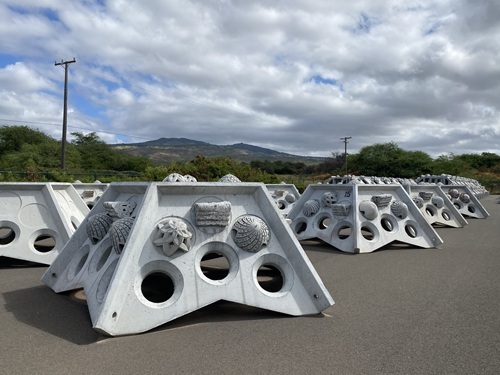
To help protect vulnerable coastal highways from erosion and rising seas, the Hawaii Department of Transportation is embarking on the first-ever effort to build an underwater “hybrid reef” on the hard rock ocean bottom south of Kalaeloa Harbor, which sits on the west coast of the “Big Island” of Hawaii.
[Above photo by Hawaii DOT]
The Kalaeloa Hybrid Reef Project – based on technology developed by the Defense Advanced Research Projects Agency or “DARPA” via its Reefense Program – integrates engineered reef structures with living coral to reduce wave energy, strengthen shorelines, and improve coastal resilience.
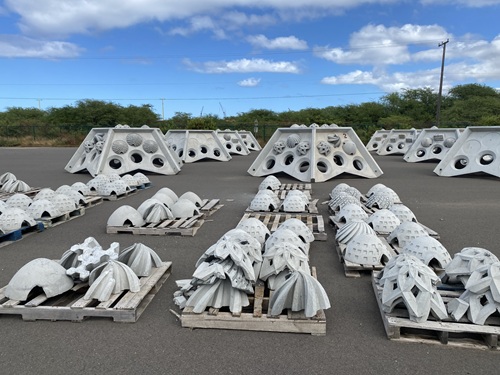
The deployment marks the first large-scale ocean demonstration of the technology following four years of research and development, noted Ed Sniffen, Hawaii DOT director.
“Success at Kalaeloa could provide a model for protecting vulnerable coastlines throughout Hawaii and beyond,” he explained in a statement. “We’re not just defending our shorelines – we’re building a resilient, self-sustaining ecosystem.”
Funded by DARPA, the hybrid reef structures were researched, developed, and deployed in collaboration with the University of Hawaii, Makai Engineering, Kuleana Coral Restoration, and other partners. Following deployment, ownership of the structures will then transfer to Hawaii DOT.
The agency explained that the Kalaeloa Hybrid Reef is a “living breakwater “designed to reduce wave energy while improving the natural habitat.” The system consists of 60 engineered, porous concrete reef mimicking structures manufactured in Hawaii that dissipate wave energy while allowing water to flow through the reef.
Special “coral settlement modules” attached to the structures will support the recruitment and growth of native corals, along with biomaterials that repel competing algae and accelerate coral growth. Those and other technologies being tested on the structure will allow the reef to develop into a healthy, self-sustaining ecosystem over time, noted Hawaii DOT.
Once deployed, the Kalaeloa Hybrid Reef will also serve as a “living laboratory,” with its long-term monitoring guided by the newly established Kalaeloa Hybrid Reef Monitoring Hui – a partnership of researchers, Hawaii DOT representatives, community organizations, and cultural practitioners that will assess the reef’s environmental, engineering, and cultural impacts.
“This project would not be possible without the partnership of the local community,” said Hawaii DOT’s Sniffen. “We are grateful to the organizations and cultural practitioners who have helped shape this effort and will continue to guide its long-term stewardship. Their knowledge and commitment are essential to the project’s success.”
The agency added that findings from this project will be shared with regulators, engineers, and coastal managers to help inform future shoreline protection projects in Hawaii and elsewhere. If successful, the Kalaeloa Hybrid Reef could provide a scalable, nature-based approach to protecting vulnerable coastlines while advancing the growing field of nature-based coastal engineering, Hawaii DOT noted.
 Top Stories
AASHTO Comments on 'Corridors of Commerce’ Program
September 18, 2026 Top Stories
