


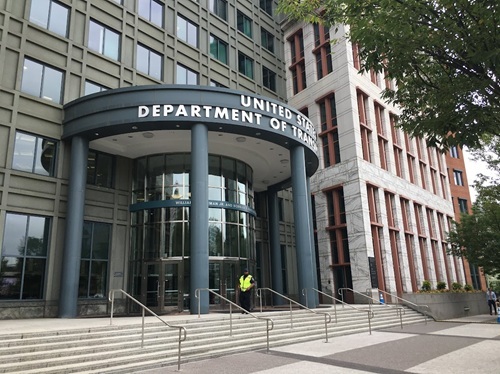
The American Association of State Highway and Transportation Officials recently provided feedback to the U.S. Department of Transportation regarding the agency’s “America’s Great Corridors of Commerce” or AGCC initiative published in the Federal Register on August 18.
[Above image by AASHTO]
Spearheaded by the USDOT’s Build America Bureau, the AGCC program is envisioned by USDOT as a voluntary nationwide effort aimed at “transforming highway and rail corridors into multi-use arteries for transmission wires, fiber optic lines, water pipelines, and other vital utilities.”
By leveraging public-private partnerships, USDOT said its AGCC initiative will give state departments of transportation and railroads the ability to lease rights-of-way or ROW – the land running alongside roads, railroad tracks, or other shared space utility tunnels – to help spur the rapid build-out of critical utility infrastructure via public-private partnerships or P3s.
In a comment letter sent to USDOT on September 11, AASHTO said state DOTs “support further exploration of these concepts” for project development possibilities that demonstrate a net public benefit, are compatible with current transportation safety and operations, and preserve the ability of state DOTs to meet future transportation needs.
“In addition, further understanding and resolution of significant legal, liability, procurement, financial, and operational issues among the states will be necessary to advance the AGCC framework into practice,” AASHTO added. “Out of deference to state authority, it is essential that AGCC remains a voluntary program.”
AASHTO further expressed “significant concern” with a September 1 memorandum issued by the Federal Highway Administration entitled “America’s Great Corridors of Commerce Guidance on the Use of Highway Right-of-Way,” which recommends “accommodation as a utility under 23 CFR part 645” as one of the two AGCC implementation pathways.
“This could be interpreted as establishing AGCC facilities as utilities entitled to access highway ROW under generally applicable utility accommodation policies,” AASHTO said. “Such an interpretation could create pressure to provide comparable access to other utility providers, raise questions regarding competitive neutrality and equal treatment of applicants, and complicate state DOT management of limited ROW resources.”
Other potential issues AASHTO highlighted in its comment letter regarding the proposed AGCC program:
- The potential for preemption of states’ authority and established rules and systems for utility coordination and permitting, property acquisition, environmental review, and planning. Currently some Utility Accommodation Policies may prohibit or restrict longitudinal utility occupancy. States must have the flexibility to maintain, modernize, and expand the system as necessary, AASHTO stressed.
- The nature of the underlying property interest may also limit a state’s ability to authorize certain uses of highway ROW, AASHTO noted. For example, certain highway ROW across the country are held through easements rather than fee simple ownership. These easements are often limited to “highway purposes” and may not provide sufficient property rights or authority to lease or grant third-party commercial rights, AASHTO said – something that may also include state or federal public lands.
- The AGCC concept introduces technical and engineering challenges that are not fully addressed by existing highway design guidance or common utility accommodation practices, AASHTO explained. These include utility separation requirements, maintenance access, emergency response, structure placement and clearances, construction impacts, drainage and groundwater impacts, and protection of future transportation improvements. Thus, state DOTs, federal agencies, utility owners, and relevant technical organizations should collaborate to develop guidance and recommended practices for utility colocation within highway ROW.
- The economic viability of the AGCC concept would likely vary significantly by state, corridor, utility type, and local market conditions, AASHTO stressed. Before advancing a multistate or nationwide program, the full range of potential benefits, costs, and risks should be identified and evaluated, including impacts on transportation agencies, utility owners, ratepayers, taxpayers, and other affected stakeholders like privately owned land adjacent to highways.
- Some states have expressed concerns about inserting new regulatory agencies and requirements into what is already a complex coordination process for highway projects. Thus “co-location” may expose state DOTs to more oversight and approvals from state or federal utility regulators, AASHTO said. Similarly, AGCC projects may bring new federal requirements to utility owners, which they may not have experience implementing.
 Top Stories
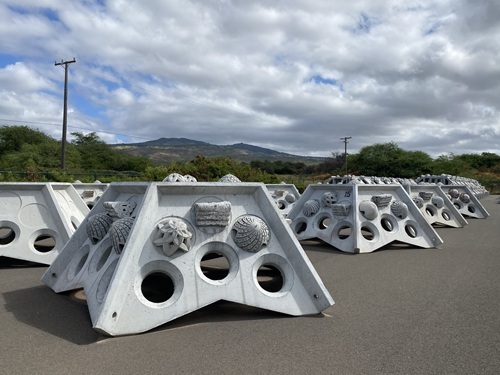
Hawaii DOT Embarks on Hybrid Reef Building Project
September 18, 2026 Top Stories
