


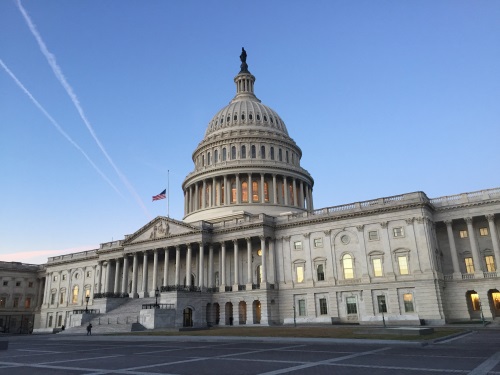
The American Association of State Highway and Transportation Officials joined 60 other organizations in calling on Congressional leadership to preserve fiscal year 2026 funding levels enacted for all federal transportation programs in the event that a short-term government funding measure or surface transportation program extension becomes necessary.
[Above photo by AASHTO]
“Any decision by Congress to reduce funding to federal transportation programs as part of any short-term continuing resolution (CR) or extension of the surface transportation programs will inject uncertainty into state and local investment decisions,” the organizations said in a July 27 letter to Congressional leadership.
Such a funding reduction could “potentially lead to delays in completing or commencing work on critical infrastructure projects that benefit the safety of our nation’s travelers, support our nation’s economy, and help create and maintain important jobs,” the groups said.
AASHTO said that Congress is starting to prepare a short-term extension of surface transportation programs as it appears a new multiyear reauthorization bill will not be enacted by September 30. The House of Representatives already has recessed until August 31, leaving the Transportation and Infrastructure Committee’s Building Unrivaled Infrastructure and Long-term Development for America’s 250th Act or BUILD America 250 Act awaiting action by the House Ways and Means Committee before consideration of the bill on the House floor.
That five-year surface transportation funding reauthorization bill allocates $580 billion for highways, highway safety, transit, and rail programs from FY 2027 through FY 2031, with $474.4 billion provided as Highway Trust Fund (HTF) contract authority.
Meanwhile, four key Senate authorizing committees – Environment and Public Works, Banking, Commerce, and Finance – have not completed the drafting of their respective titles and the Senate is expected to recess on August 7 and not return until September 14.
Concurrently, a CR or “stop-gap” annual funding bill is in the works for the start of FY 2027 on October 1. The House has passed three of the 12 FY 2027 appropriations packages (Military Construction/Veterans Administration, Agriculture, and National Security/Department of State) but the Senate has yet to release text of its FY 2027 appropriations bills. As such, AASHTO does not expect any of these appropriations bills to be enacted by the end of the current fiscal year on September 30.
Prior to adjourning for its August recess, the House passed a “clean” CR on July 21 that would fund the federal government through December 4. The Senate is currently negotiating their own version of a CR that may include funding adjustments and “anomalies” for certain programs, with the expiration date of December 11. The final CR will reflect further negotiations between the House and the Senate, AASHTO said.
AASHTO also noted that the funding situation this fall is further complicated by the sunsetting of multiyear advance appropriations programs in the Infrastructure Investment and Jobs Act or IIJA that supplemented HTF and annual General Fund appropriations – including bridge and National Electric Vehicle Infrastructure or NEVI formula programs, rail grants, and many others.
Advance appropriations of General Funds for all five years of the IIJA were designated in Division J as emergency spending exempt from budget enforcement rules, which was a highly unique funding mechanism for transportation programs and may be difficult to replicate in the future, AASHTO noted.
Given the unusual convergence of expiring program authorities, annual appropriations, and advance appropriations, AASHTO said a concerted effort by Congressional leadership will be needed to prevent disruptions to IIJA program funding while a full reauthorization bill is developed and enacted – which is why maintaining current FY 2026 funding levels in the meantime is so critical.
“When Congress supports federal transportation investment, every community stands to benefit with enhanced mobility, safer commutes, and a strong economy,” the industry letter stressed. “We look forward to working with you to achieve these outcomes with strong congressional support for transportation.”
 Top Stories
Top 12 America’s Transportation Awards Finalists Revealed
September 11, 2026 Top Stories
