


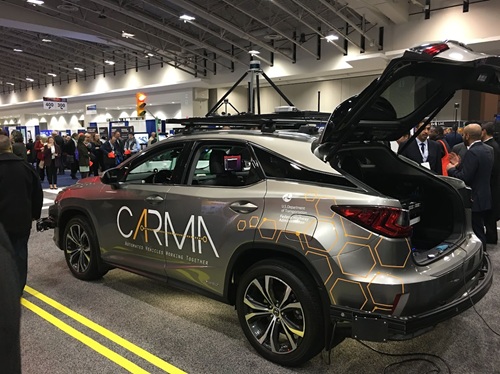
The U.S. Department of Transportation recently unveiled a revamped national strategic plan for automated vehicles or AVs – furthering ongoing efforts, the agency said, to “slash unnecessary red tape, modernize critical regulations, prioritize safety, and enable the safe development and deployment” of AVs on U.S. roadways.
[Above photo by AASHTO]
The USDOT said its revised AV Strategy is built around four core objectives:
- Prioritize Safety: Provide guardrails to support and improve safety as the AV industry grows – including standards for automated vehicle competency.
- Provide Regulatory Certainty: Modernize existing regulations; remove unnecessary barriers; streamline processes; all while providing clarity, predictability, and consistency.
- Promote American Innovation: Expand commercial availability and operation for passenger and freight applications domestically and promote U.S. interests abroad.
- Facilitate Interoperable Corridors: Convene national stakeholders to promote seamless cross-state interoperability within the transportation system.
Sean Duffy, USDOT secretary, said in a statement that AVs are one of several new technologies that offer the “exciting promise” of reducing roadway fatalities, enhancing mobility, and fundamentally reshaping how people move for the better.
“This strategy outlined a plan to empower our innovators to build faster, smarter, and safer than ever before,” he added.

[Editor’s note: In line with this new strategy, the Federal Transit Administration recently provided $25 million to the Chattanooga Area Regional Transportation Authority or CARTA to operate up to six AV shuttles in that city’s downtown area.]
The USDOT’s updated AV strategy plan is the latest in a series of AV-focused efforts by the agency and its modal administrations.
In April 2025, the National Highway Traffic Safety Administration unveiled a new “AV framework” to help establish a single set of national regulations to avoid what the agency termed a “harmful patchwork” of state laws – a rulemaking effort the American Association of State Highway and Transportation Officials provided feedback on to NHTSA in early September this year.
AASHTO also commented on NHTSA’s ongoing review of Federal Motor Vehicle Safety Standards (FMVSS) in light of the development and deployment activities related to AV and Automated Driving Systems (ADS) technologies in February this year.
Concurrently, state departments of transportation remain heavily involved in testing the safe deployment of AVs and related technologies across the country.
For example, the District of Columbia Department of Transportation (DDOT) is hosting an “AV Observation Zone Challenge” that seeks to develop a sensing technology package capable of detecting and identifying AVs operating within Washington, D.C., along with data that supports the observation and analysis of AV fleet operations.
That ongoing project will allow DDOT and its academic partners to observe autonomous vehicle behavior and compare it with baseline data collected from human-driven vehicles. The findings will help inform future discussions regarding AV testing, deployment, and regulation in Washington, D.C., the agency said.
Meanwhile, in February, the Federal Highway Administration approved the Georgia Department of Transportation to lead a ‘Vehicle-to-Everything’ or V2X pooled fund study; a $3.2 million collaborative inter-state initiative aimed at helping shape the future of connected vehicle technologies in the transportation sector.
That study focuses on the high-priority research needs related to V2X – a wireless technology that enables vehicles to communicate with other cars – as well as real-world use cases to improve safety, traffic flow, and automated driving capabilities.
The study currently includes 20 U.S. state departments of transportation and Transport Canada, with additional state DOTs expected to join the initiative, Georgia DOT noted.
 Top Stories
FRA Issues $2.3B in CRISI Grants to 105 Rail Projects
October 23, 2026 Top Stories
