


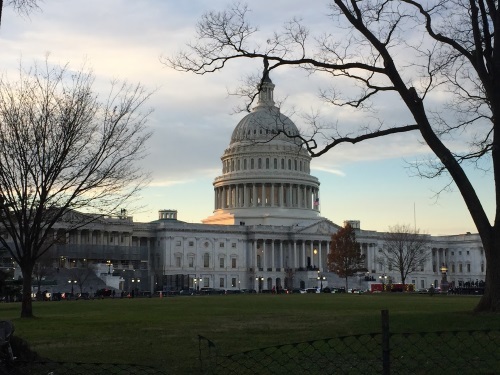
The House of Representatives Transportation and Infrastructure Committee passed a five-year surface transportation reauthorization bill after a marathon 15-hour legislative markup session that began on May 21 and ended in the wee hours of May 22. The committee adopted the bill by a vote of 62-2 with three members not voting.
[Above photo by AASHTO]
That bill – H.R. 8870, knows as the Building Unrivaled Infrastructure and Long-term Development for America’s 250th Act or BUILD America 250 Act – authorizes roughly $580 billion over fiscal year 2027 through FY 2031, with $474.4 billion provided as Highway Trust Fund (HTF) contract authority.
Roughly $106 billion of the bill’s funding would be subject to annual appropriations because – unlike the Infrastructure Investment and Jobs Act or IIJA, the current five-year reauthorization package from 2021 – the BUILD America 250 Act does not include General Fund advance appropriations.
By modal administration, the bill provides over its five-year period the Federal Highway Administration with $376 billion; the Federal Transit Administration with $87.6 billion; the National Highway Traffic Safety Administration with $5.7 billion; the Federal Motor Carrier Safety Administration with $5 billion; and the Federal Railroad Administration with $64.7 billion, including $31.1 billion for Amtrak.
The bill requires states to collect $130 in annual registration fees on electric vehicles and $35 per year from plug-in hybrids, escalating biennially starting in 2029 and capped at $150 and $50 per year, respectively – raising just under $10 billion in the first five years and $29 billion over the first 10 years.
The proposed legislation establishes a revised bridge formula program funded at $9.2 billion per year from the HTF and authorizes $2 billion per year for the “Bridge Completion Program” from the General Fund, subject to future appropriations.
The package creates the Surface Transportation Accelerator Grant discretionary program with $2.4 billion per year from the HTF and continues the Safe Streets and Roads for All program, ramping up to $1 billion in FY 2031 from the HTF.
The bill also establishes a new federal framework for Automated Driving System‑equipped commercial motor vehicles operating in interstate commerce, including a safety standard rulemaking to require a safety case and incident reporting, similar to what was included in the SELF-DRIVE Act.
It also repeals the Carbon Reduction formula program; repeals the Reconnecting Communities and Neighborhood Access and Equity grant programs; and eliminates the formula funded component Promoting Resilient Operations for Transformative, Efficient, and Cost-Saving Transportation or PROTECT formula program while continuing the discretionary grants.
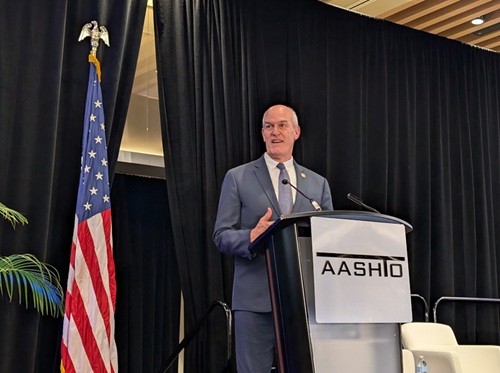
“This bill makes historic investments in our bridges and other critical infrastructure, reduces costs and delays in building, ensures states have the resources and flexibility they need, bolsters the Highway Trust Fund, fosters innovation, and provides a framework for safely integrating autonomous commercial motor vehicles onto our highways,” noted Rep. Sam Graves (R-MO), chair of the House T&I committee, in a statement.
“You can’t have a big-league economy with little-league infrastructure,” added Rep. Rick Larsen (D-WA), the committee’s ranking member. “The BUILD America 250 Act will create good paying jobs while restoring aging bridges, repairing crumbling roads, and supporting safe, accessible rail, transit and bike infrastructure.”
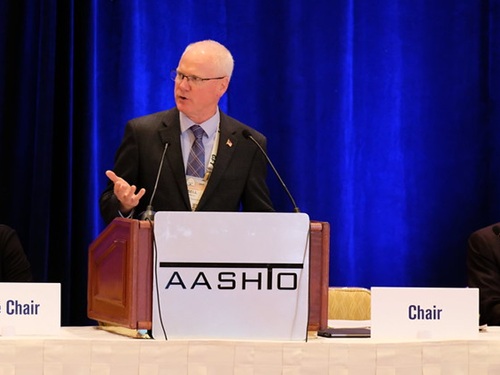
Russell McMurry, the 2025-2026 president of the American Association of State Highway and Transportation Officials and commissioner of the Georgia Department of Transportation, praised how the bill served as “an essential and a bipartisan acknowledgement of the need for maintaining the continuity and reliability of infrastructure projects and programs” delivered by state departments of transportation.
“The BUILD America 250 Act reflects many of AASHTO’s core policy principles,” he said in a statement, “such as streamlining programs with common objectives, enhancing the efficiency of environmental review and permitting processes to expedite project delivery, and upholding formula-based federal funding to states and other initiatives supported by the long-standing user pay model that supports the Highway Trust Fund.”
At the beginning of the markup session, a bipartisan Graves-Larsen manager’s amendment incorporating a large number of both Democratic and Republican amendments was approved by voice vote on top of the base text (Amendment in the Nature of a Substitute—or ANS) released on May 19.
The manager’s amendment added a broad range of things, such as: a Hawaii Marine Highway System; makes removal or modification of tunnels and the raising of bridges eligible for bridge formula funding; requires states to consider geographic diversity in the selection of bridge projects in the state competitive grant portion of the new bridge formula program; recognizes that national electric toll collection interoperability is a critical component of the nation’s transportation system; and makes airport authorities eligible for Consolidated Rail Infrastructure & Safety Improvements or CRISI grants.
Other amendments added to the bill by the committee during the markup session included:
- Begich 129: adds two Alaska corridors to the list of High Priority Corridors (approved by voice vote).
- Bresnahan 049: limits duty of care of rental or lease vehicle owners to component parts or optional equipment (approved by recorded vote of 36-28).
- Collins 025: limits states from collecting taxes and other revenues from commercial motor vehicles (approved by recorded vote of 33-31).
- Figures 066: adds eligibility for maritime road access to Surface Transportation Block Grant Program or STBGP (approved by recorded vote of 51 to 13).
- Hoyle 064: makes bus rapid transit project eligible for Transportation Infrastructure Finance and Innovation Act or TIFIA (approved by voice vote).
- Johnson (SD) 077: creates a pilot program for 6-axle vehicles weighing 91,000 points on the Interstate System (approved by recorded vote of 35-29).
- Knott 016: strengthens the FMCSA registration system to detect cargo theft/fraud (approved by voice vote).
- McDowell 045: adds rail station modernization to Railroad Rehabilitation and Improvement Financing or RRIF eligibility (approved by recorded vote of 64 to 1).
- Nehls 091: increases the federal cost share for activities funded under the Rail Technology and Asset pilot program from 50 percent to 80 percent (approved by voice vote).
- Nehls 093: allows peer to peer car sharing platforms the same liability as rental car companies (approved by recorded vote of 36-28).
- Nehls 094: adds the text of H.R. 7748, the Railway Safety Act (approved by recorded vote of 54-11).
- Owens 047: allows the use of ridership forecasts that account for population density and population growth rate when evaluating Capital Investment Grant program projects (approved by voice vote).
- Patronis 047: allows a nationwide weight waiver for stringer-steered combination auto transporters up to 80,000 pounds (approved by recorded vote of 32-31).
- Taylor 081: requires a GAO study on “chameleon carriers” (approved by voice vote).
- Titus 294: adds the text of H.R. 7784, the Secure Tracks Act (approved by recorded vote of 35-31).
- Titus 307: requires hazmat endorsement on CDLs for drivers and carriers that transport lithium batteries (approved by recorded vote of 40-24).
- Van Drew 120: bans the transportation of horses for slaughter for human consumption in a motor vehicle or double-stacked trailer (approved by recorded vote of 34-30).
- Westerman 076 (text not available): adds subgrade and base course materials to the list of innovative technologies under STBGP (approved by recorded vote of 52-12).
 Top Stories
AASHTO Safety Summit: Safety as a ‘Core Design Element’
October 2, 2026 Top Stories
