


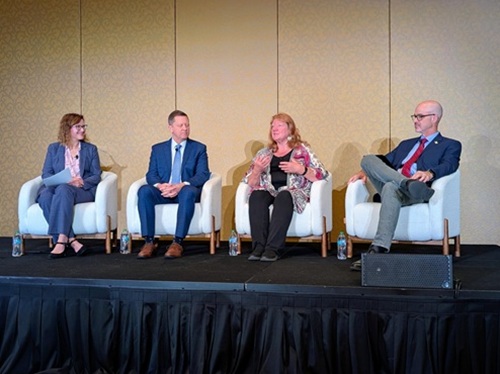
At the American Association of State Highway and Transportation Officials 2025 Annual Meeting in Salt Lake City, a knowledge session detailed how multistate highway corridor initiatives can improve safety, mobility, and resiliency across broad regions of the United States.
[Above photo by AASHTO]
Alanna Strohecker, senior vice president of AECOM – the session’s sponsor – moderated a panel that featured Tracy Larkin Thomason, director of the Nevada Department of Transportation; Scott Marler, director of the Iowa Department of Transportation; and Marc Williams, executive director of the Texas Department of Transportation.
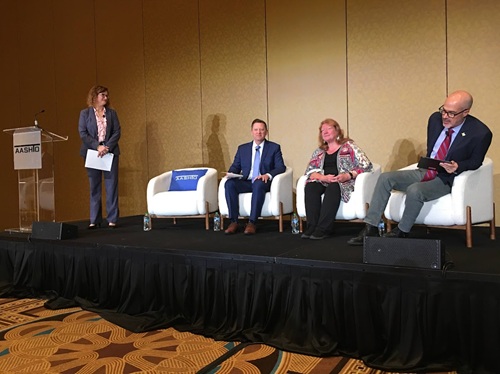
“The movement of people and goods does not stop at state lines – and neither should our approach to planning, operations, and technology deployment,” Strohecker noted in her opening remarks.
“State DOTs are increasingly working together through [highway] corridor initiatives to address shared challenges from truck parking and emergency road closures to digital infrastructure, as well as inclement weather challenges,” she added. “These multistate partnerships demonstrate how coordinated [infrastructure] investments, data sharing, and interoperable strategies can improve safety, mobility, and resiliency across the country.”
Nevada DOT’s Larkin Thomason stressed that, before states can collaborate in such partnerships, they have to establish how to communicate effectively with one another – especially in emergency situations.
“It doesn’t matter what the technology is: Satellite, fiber, microwave, or cellular,” she explained. “But we need to be able to talk to each other. And then the next thing after that is, regardless of whatever [communication] platforms we’re using, at [our] borders they must be interoperable, so that the platforms can talk to each other so we are all linked together. And it sounds very simple. But then, you also see that we’re laying the [communication] foundation not just for the transportation sector, but for other sectors as well.”
Iowa DOT’s Marler noted that such multistate collaboration is also about modernizing state transportation systems. “That’s really at the end of the day what this conversation is about – modernizing and transforming the systems that we own and manage in all of our states,” he explained.
Marler stressed that interstates remain the “backbone” of the U.S. economy and individual mobility as well.
“There’s roughly 800 billion vehicle miles travelled on our nation’s interstates; they are vital for moving people and goods. And that’s really why we’re talking about this collaboration effort,” he said. “The ‘secret sauce’ as a nation is our interstate system in terms of making us healthier, making us wealthier, and enhancing our national security. So, it is about infusing a ‘digital layer’ with the physical [interstate] assets that we own and operate across all of our jurisdictions. That really means focusing on bringing about that analog-to-digital transformation.”
TxDOT’s Williams elaborated on the importance of that “digital transformation,” noting that mobile technologies, digital infrastructure, and telematics help develop a “seamless” interstate system for personal travel and freight transportation.
“Freight, for example, does not stop at the Texas border – it travels throughout the United States,” he emphasized.
“Easing that flow of goods and products relies upon effective communication and coordination between the states,” Williams added.
Nevada DOT’s Larkin Thomason noted that ultimately means creating a “travel experience” whereby a person or freight shipment moving from the West Coast or East Coast or to the south receives a “uniform” set of data regarding road closures due to crashes or weather or other events far in advance so they can be rerouted.
“Because when we have an incident on I-15 in California, we have to push that information quickly all the way back to Utah, Arizona, and even Iowa – letting them know because of how that incident affects travel for them,” she said.
 Nation
Entries Sought for 2026 America’s Transportation Awards
February 27, 2026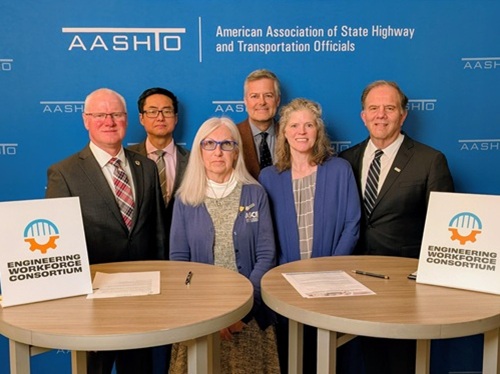 Nation
