


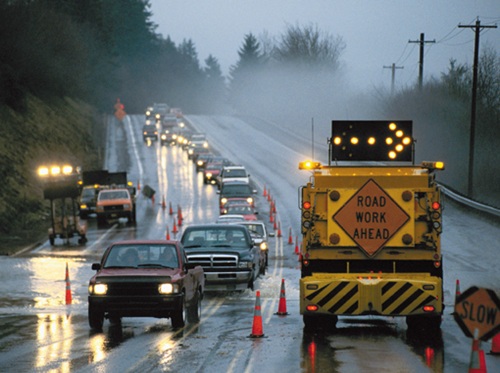
The Federal Highway Administration recently unveiled a new set of transportation innovations developed through its Every Day Counts or EDC program to help states build projects faster while boosting safety.
[Above image by FHWA]
The agency said its EDC program identifies processes and/or technologies states have used successfully in the field and, in turn, provides technical assistance to help other states fast track them for their own use.

From smarter nighttime work zone practices to high-reliability data sharing tools, FHWA said EDC innovations have already been adopted by more than 15 states. Now in its eighth round, this program brings together state transportation departments, local governments, tribes, and the private sector to modernize American infrastructure.
“The Every Day Counts program has rapidly deployed proven technologies and processes that can be shared and implemented across states to deliver a safer and faster transportation network for Americans,” said Sean McMaster, FHWA administrator, in a statement. “This latest round of innovations is taking transportation solutions to a new level to ensure our roads and bridges are built better and in less time.”
The most recent innovations being promoted via the EDC program are:
- Advancing Nighttime Work Zone Safety: This initiative aims to offer tools to help transportation agencies adopt safer nighttime work zone practices.
- Beyond Bid-Build – Innovative Project Delivery: Alternative contracting methods offer more flexible tools to states; bringing in expertise earlier and reduce risks and thus helping agencies deliver projects faster, smarter, and with better long-term outcomes.
- Connected Corridors: This program helps states work in a coordinated, shared approach, while ensuring each agency retains control over its own data and platforms. Reliable data sharing and common quality standards help improve safety and efficiency while supporting more innovation on a national scale.
- Integrated Digital Project Delivery: This innovation helps transportation agencies improve the way they plan, build, and maintain projects by connecting people and information in one system. With shared digital models and easy to use online tools, teams can quickly find accurate data, solve problems sooner, and deliver safer and more reliable projects.
- Subsurface Utility Engineering (SUE): Unexpected utility “hits,” caused by items such as electric system cables, are a major cause of transportation project delays; adding costs and increasing safety risks. SUE helps fix this problem by using proven tools to locate and map utilities early in the planning process. With better information upfront, agencies can avoid surprises and keep projects on schedule.
- UAS 2.0 – Innovative Infrastructure Management: Short for “Unmanned Aerial System,” this UAS initiative offers transportation agencies new opportunities to improve how they inspect and maintain critical infrastructure. Building on the nationwide success of earlier drone adoption, these next generation tools help agencies work more safely, efficiently, and consistently. This innovation supports better decisions and stronger infrastructure management over time.
 Nation
Entries Sought for 2026 America’s Transportation Awards
February 27, 2026 Nation
