


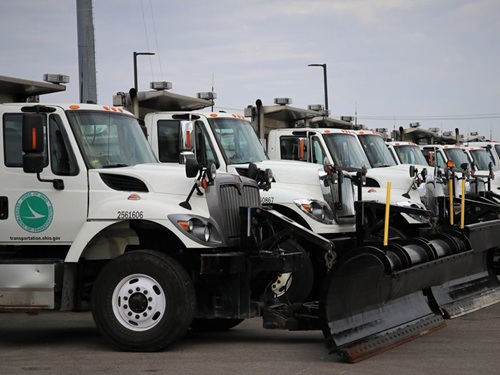
Across the country, state departments of transportation are finishing up their preparations for winter operations.
[Above photo by the Ohio DOT]
For example, crews from the Ohio Department of Transportation are inspecting snow-fighting equipment and ensuring that materials and drivers are ready to go.
The agency said in a statement it deploys nearly 3,000 drivers who often work 12-hour shifts during snow and ice events. While most are full-time employees, about 500 drivers are hired seasonally. In addition to full-time and seasonal drivers, Ohio DOT said it also uses teams of “auxiliary drivers” during severe weather events; full-time Ohio DOT employees who normally do other tasks and only plow snow when needed.
[Editor’s note: Last winter, Ohio DOT rerouted one of its snowplow operators to help an ambulance crew transfer a sick infant from one hospital to a more specialized facility – ensuring that the ambulance had a clear path all along its journey.]
The agency added that those drivers clear more than 43,000 lane miles of state and U.S. routes outside municipalities and all interstates in Ohio, except the Ohio Turnpike, with a goal of having primary routes cleared within two hours and secondary routes within three hours of the end of a snow event. Last winter, crews hit that goal 99.3 percent of the time, Ohio DOT noted.
Other state departments of transportation have made similar preparations for winter operations as well, such as the Washington State Department of Transportation, Pennsylvania Department of Transportation, and the Missouri Department of Transportation which recently conducted a statewide winter storm drill for its personnel.
Out west, the California Department of Transportation recently enlisted the help of helicopters to change out heavy gas canisters atop Mount Downs near Juno Lake in the east-central portion of the state along State Route 158; cannisters used to trigger smaller avalanches during inclement weather that prevent larger buildups of snow that could block critical roadways.
Meanwhile, the Utah Department of Transportation produced a video that highlighted the critical skills of the men and women who maintain and repair the agency’s snow removal equipment.
On a completely different track, a recent blog post by the Iowa Department of Transportation delved into the critical role played by the Standing Corn Snow Fence program in keeping the state’s roads clear of snow.
Through this program, the agency partners with local farmers who have fields along state highways; especially in open, flat areas. After harvest, farmers leave between six and 24 rows of corn standing to serve as an effective natural snow fence. The corn slows or even stops snow from blowing and drifting across the highway by trapping it between the stalks, Iowa DOT noted, and if a farmer can’t or would prefer not to leave rows of standing corn, round hay bales can also be used as an alternative snow fence option.
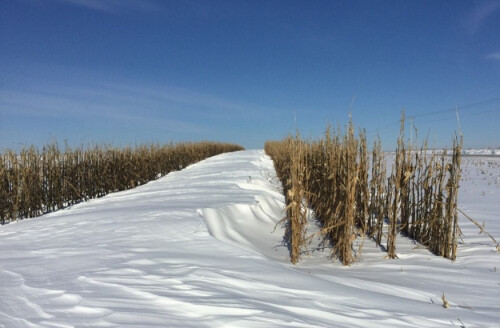
In return, the Iowa DOT pays farmers based on the statewide average price per bushel of October new crop corn determined at the close of business on August 1. The agency then adds an extra $2 per bushel to the statewide price as an incentive to the farmer. For 2026, that came out to $6.25 per bushel. Meanwhile, for round hay bales, farmers are paid $1 per linear foot.
“Studies show that plowing snow costs 100 times more than trapping it with a snow fence, so these partnerships really pay off,” explained Craig Bargfrede, Iowa DOT’s winter operations administrator. “Farmers know their land. We know the roads. Together, we can identify the best spots for snow fences and even collaborate on which corn hybrids are most resilient to constant winter winds.”
Finally, on the technology side, the Kansas Department of Transportation recently launched a new “Plow Locations Tool” that displays active snowplow locations on state highway; a mapping tool is hosted on KanDrive.gov, the agency’s 24/7 resource for highway and weather conditions, which refreshes snowplow location data every 60 seconds.
“We’re committed to providing Kansans with timely and reliable information during winter weather events,” said Calvin Reed, Kansas DOT’s secretary, in a statement. “This new tool helps travelers see where crews are actively working while also providing a better understanding of the effort required to keep highways open and safe during a storm.”
In addition to seeing active plow locations, Kansas DOT will also have 12 plow trucks equipped with cameras to display dashcam images of roadway conditions on KanDrive. On the map, each plow appears as orange arrow icons pointing in its direction of travel, with the 12 camera-equipped plows appearing as blue truck icons.
“Behind every plow shown on the map is a Kansas DOT employee working to improve travel conditions,” Reed stressed. “This tool gives the public a real-time view of that work and another resource to help them make informed travel decisions.”
 Nation
AASHTO Offers FHWA Performance Management Insights
October 23, 2026 Nation
