


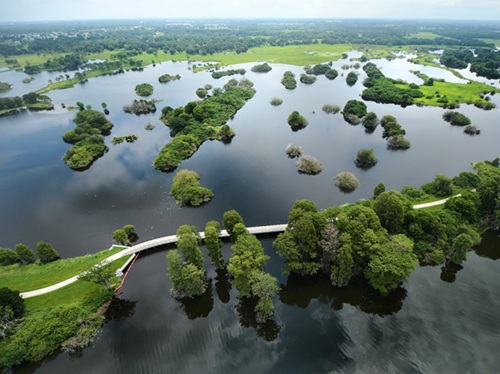
The American Association of State Highway and Transportation Officials recently sent a 38-page comment letter to the U.S. Environmental Protection Agency and U.S. Army Corps of Engineers (USACE) regarding a supplemental notice of proposed rulemaking concerning the definition of “Waters of the United States” or “WOTUS” as published in the Federal Register on September 9.
[Above photo by Florida DOT]
AASHTO stressed in its October 9 comment letter – as well as in previous ones in January and in April 2025 – that it recommends a WOTUS definition that is both protective of water quality and natural resources and straightforward for the regulated community to understand and apply.
“AASHTO supports EPA’s and USACE’s effort to provide a clearer and narrower test to define WOTUS [and] the supplemental rulemaking begins to address AASHTO’s concern with reliance on ‘wet season,’ ‘dry land,’ and ‘upland’ definitions by providing a more measurable assessment,” the organization said.
“The concepts of ‘perennial,’ ‘relatively permanent,’ and ‘continuous surface connection’ provide greater clarity for state departments of transportation, particularly in areas where precipitation, soil saturation, drought, flooding, and seasonal conditions make a generalized wet season test difficult to apply,” AASHTO added.
However, the group stressed that the supplemental rulemaking does not satisfactorily address ordinary conditions, anomalous events, regularly occurring dry spells, interruptions lasting more than 30 consecutive days, and perennial surface water before, during, or after prolonged drought.
It also does not resolve uncertainty about the monitoring and documentation needed to support jurisdictional determinations, AASHTO stressed.
“Without a clear implementation framework, field staff and regulators may reach different conclusions about whether a transportation feature creates, maintains, or interrupts a jurisdictional connection,” AASHTO noted. “State DOTs carry substantial permitting and administrative responsibilities, along with significant field inspection and monitoring demands. Without practical implementation assistance and clear guidance, the final rule on the definition of WOTUS may add to these burdens and impact project delivery and postconstruction maintenance.”
To address all of the above concerns, the organization made several recommendations:
- Establish a nationally consistent, field-workable, and transition-ready process that clarifies how anomalous events and regional hydrologic conditions affect the perennial flow test; that defines the evidence needed to demonstrate perennial flow and a continuous surface connection; and that provides representative examples, decision tools, documentation standards, and training for agency staff and regulated entities.
- EPA and USACE should also coordinate implementation across districts and regions so similar transportation features receive consistent jurisdictional treatment.
- Support “transportation focused approaches” to WOTUS issues, such as by creating a federal-level transportation separate storm sewer system permit; integrating stormwater measures into transportation asset management; expanding federal funding eligibility for maintaining stormwater and aquatic resource assets; establishing an appropriate nationwide permit for transportation infrastructure; making federal transportation liaison programs stronger; and increasing opportunities for states to assume additional federal responsibilities.
 Nation
USDOT Loans to Support I-81 Improvements in Virginia
October 16, 2026 Nation
