


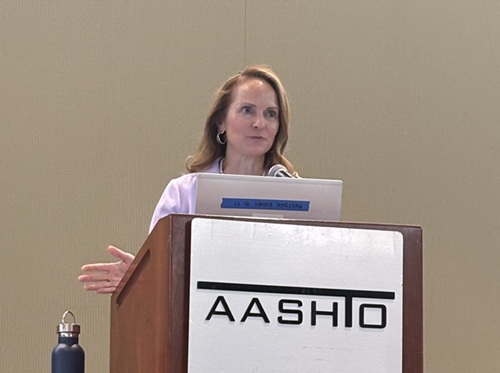
A session at the American Association of State Highway and Transportation Officials 2026 Safety Summit in Hartford, CT, on September 28 explored evolving road user trends and highlighted innovative strategies states are using to address safety challenges and reduce roadway fatalities.
[Above photo by AASHTO]
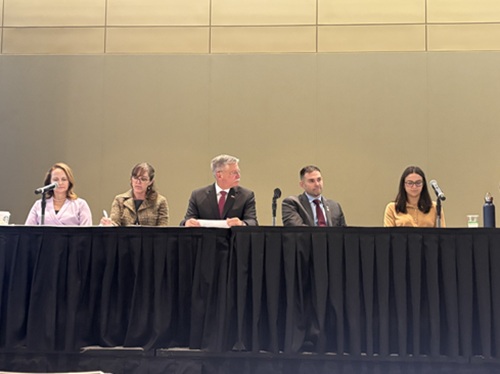
Entitled “The Latest in Road User Behavior Strategies” and moderated by Teresa Haslauer, highway safety program manager for the New York State Department of Transportation, the session’s panel featured Sophia Ventrelli, a forensic scientist; Alfred Croteau, a surgeon with the Division of Acute Care at Hartford Hospital; Michael Hanson, director of the Minnesota Office of Traffic Safety; Laura Sandt, co-director of the University of North Carolina Highway Safety Research Center; and Jane Terry, director of the Office of Impaired Driving and Occupant Protection at the National Highway Traffic Safety Administration.
Ventrelli discussed how she analyzes samples from impaired drivers to identify trends in crashes and impaired driving. She noted that Connecticut has eliminated “stop testing,” a practice in which toxicology labs stop testing for drugs once a driver’s blood alcohol level exceeds a set threshold – potentially overlooking other impairing substances.
As a result, the state can gather more comprehensive data on impaired driving and better understand the factors contributing to crashes.
“None of this would be possible without the Connecticut Department of Transportation,” said Ventrelli. “We wouldn’t be able to do it without them, and we hope to continue the advancement of toxicology testing panels.”
Hartford Hospital’s Croteau came to the discussion from the healthcare field rather than transportation. As an acute care surgeon, he regularly treats patients injured in crashes involving impaired drivers. But his connection to the issue is also deeply personal: his cousin, Brooke, was killed in a drunk driving crash. Reflecting on that loss, Croteau described the lasting impact impaired driving can have on families and communities.
“I remember being in a room with hundreds of kids who were sad and crying. I remember sitting in this room and listening to my cousin Brooke, who was killed by a drunk driver,” said Croteau. “The effects of drunk driving and intoxication behind the wheel really do permeate the rest of people’s lives. My older cousin was so full of life and was taken, along with a group of six other teenagers, due to drunk driving.”
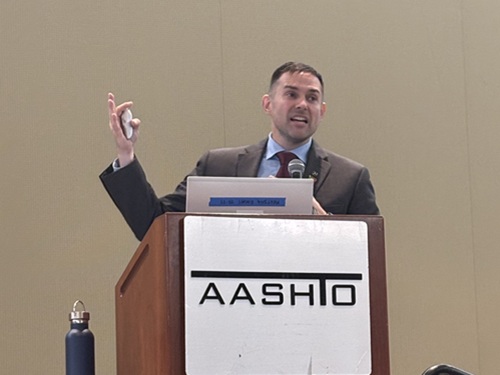
With one in three traffic fatalities involving alcohol, Croteau has partnered with the Connecticut DOT to help achieve the state’s goal of zero roadway deaths. While fatalities are trending downward, he stressed that there is still important work to be done.
“We treat the consequences of accidents. Prevention is part of our mission,” said Croteau. “We have an obligation for community outreach. I train future trauma students. I can’t save every patient, but I can teach and train people to move forward. This is my community. I have to drive to work and as part of this community, I don’t want it torn apart.”
Meanwhile, Hanson underscored the importance of dispelling common myths about impaired driving.
While highlighting safety measures such as rumble strips and emerging technologies, he underlined that transportation agencies need to account for human behavior in addition to safer road design, he said.
Building on the discussion of human behavior and roadway safety, North Carolina’s Sandt highlighted emerging trends in impaired driving and the importance of using data to better understand risk.
She pointed to recent figures showing that while self-reported binge drinking declined to 19.5 percent in 2025 from 21.7 percent in 2021, marijuana use increased to 21.2 percent from 19 percent over the same period.
Sandt stressed that identifying these trends can help agencies deploy resources more effectively. Sandt also emphasized the need for stronger action and better data to identify the root causes of crashes.
“We’re often missing the data needed to identify underlying vulnerability and heightened risk,” said Sandt. “We know even with imperfect data, we can take action now.”
NHTSA’s Terry also called for more data to inform how the transportation industry approaches road user behavior.
Emphasizing that strong crash data is critical to the safe system approach, she pointed to resources such as the Model Minimum Uniform Crash Criteria 6th Edition and the Driving Under the Influence of Drugs evaluation tool as valuable tools for helping transportation agencies better understand crashes and improve roadway safety.
“We need more and better data. If we don’t know the data, we can’t find better solutions,” Terry explained. “When a law enforcement officer or a judge encounters somebody, they know whether that person has been arrested previously for drunk driving. If you can determine that someone has a recurring problem, you need to dig a little deeper to find a solution.”
 Nation
AASHTO Safety Summit: Engaging the Public in Safety
October 2, 2026 Nation
