


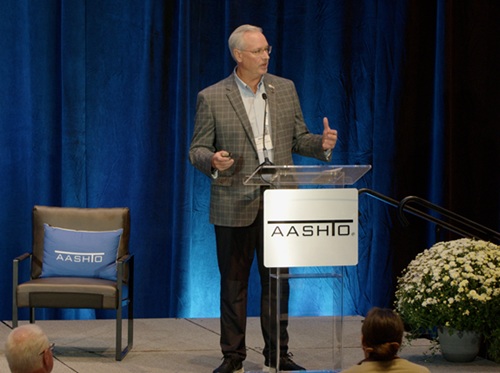
A session at the American Association of State Highway and Transportation Officials 2026 Safety Summit in Hartford, CT, on September 28 showcased how public information campaigns and programs can encourage safer driving habits while educating the public on roadway safety initiatives – efforts that can make a huge difference in saving lives.
[Above photo by AASHTO]
Entitled “Engaging the Public on Safety” and moderated by Eva Zymaris, spokesperson for the Connecticut Department of Transportation, the session’s panel featured Tim Kerns, director of the Maryland Highway Safety Office within the Maryland Department of Transportation; Marygrace Parker, freight and interim TSMO program director for The Eastern Transportation Coalition; and Mike Lutzenkirchen, executive director of the Lutzie 43 Foundation.
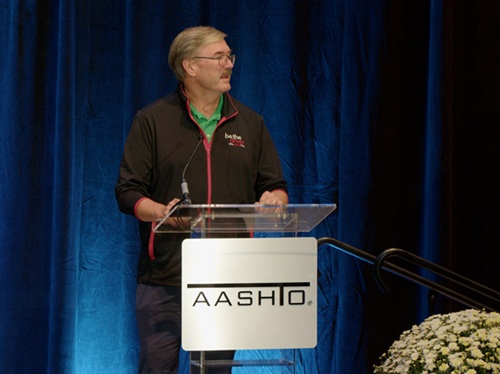
To kick off the conversation, Kerns highlighted the Maryland DOT’s longstanding Be the Driver initiative and its new Slow the Fast Down campaign, which emphasizes that driving safely is more important than arriving quickly in order to save more lives on the Maryland roadways.
Launched in September 2020, the statewide Be the Driver campaign was created as a comprehensive highway safety initiative designed to promote safe driving behaviors and reduce traffic fatalities. From animated shorts to features at major sports arenas, the campaign educated the public on safe driving habits.
Then, six months ago, Maryland DOT said it decided to go one step bolder and create the Slow the Fast Down campaign. With billboards across the state, this campaign has received a massive amount of media attention. On social media alone, this initiative garnered 13 million impressions and 500 engagements in just six months.
Kerns noted that the campaign succeeded in generating public attention, but the ultimate measure of success is whether it changes driver behavior.
“We do know it made the news, so if nothing else, we made it popular,” he said. “We need to tie it to high-visibility enforcement campaigns to be able to see what goes on and whether it’s actually slowing people down, because that’s the ultimate goal. We want people to slow down.”
Kerns underscored that Maryland recorded 485 traffic fatalities last year, though the state has seen encouraging progress as fatalities are 10 percent to 12 percent lower this year compared to the same time last year. Despite those gains, speeding remains a major concern, contributing to nearly one-third of all traffic deaths.
“We had a couple of very high-profile crashes in Maryland over the last couple of years. We lost six construction workers in what was definitely a high-speed crash on the [Baltimore] Beltway,” he stressed. “We’ve also recently lost two highway workers in two different crashes, one outside of D.C. and the other on Maryland’s Eastern Shore. That brought a little bit more attention to highway safety and what we’ve been trying to do [with these safety campaigns].”
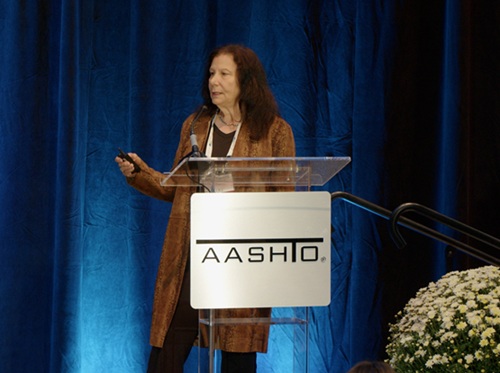
The Eastern Transportation Coalition’s Parker spotlighted a nationwide effort to tackle a growing transportation challenge: bridge strikes.
“It’s a serious safety issue. But you’ve got to get people to personalize it,” she said. “We want to target those drivers who are maybe not always using the same vehicle. Those drivers who are non-CDL drivers getting behind the wheel of a vehicle that doesn’t look like their passenger car.”
Parker added that her organization’s Bridge Strike Mitigation Working Group, which includes 20 states and Washington, D.C., developed the Check Your Height, Know It’s Right campaign to encourage drivers to verify vehicle clearances before hitting the road and help reduce costly, disruptive, and potentially dangerous bridge crashes.
Parker praised the AASHTO Safety Summit for equipping her with a strong platform to amplify the campaign.
“We went to the AASHTO Safety Summit last year and did a poster session,” she stressed. “We got a lot of interest, and we met a lot of friends that were interested outside the coalition and doing a bridge strike campaign.”
In July 2026, 33 states participated in the bridge strike mitigation awareness campaign – utilizing social media, videos and graphics to spread the message.
To round out the panel, Lutzenkirchen highlighted the work of the Lutzie 43 Foundation, which was established after his son, Philip Lutzenkirchen, died in a distracted driving crash in 2014. Phillip – a standout tight end at Auburn University – was a passenger in the vehicle and drunk at the time of the crash. He was not wearing a seatbelt and died after being ejected from the vehicle following the crash.
Today, the foundation carries forward his legacy by promoting safer driving habits and encouraging motorists to make responsible choices behind the wheel.
“Many of you are here because of your profession. I come here as a road safety advocate,” said Lutzenkirchen. “We believe safe roads start with infrastructure, vehicles, and people. I challenge you to change the order a little bit and maybe put people first, vehicles in the same spot, and infrastructure at the back end.”
The Lutzie 43 Foundation is working to make its 43 Key Seconds initiative a nationally recognized symbol for ending distracted and impaired driving. The campaign encourages drivers to take 43 seconds before getting behind the wheel to prepare for a safe trip and commit to making smart decisions on the road.
To date, the initiative has reached more than 30,500 high school students, 100 public and private schools, and 40 safe driving summits. Over the years, Lutzenkirchen said the foundation has built partnerships with organizations across the country to share Philip’s story and promote safer driving practices.
“Some of the partnerships that we’re able to develop because of who my son was, what the story is all about, and our willingness to tell the story and not hide the fact that Philip was drunk,” he explained. “Our friends at Georgia Department of Transportation have funded many of these [presentations]. They funded 33 of these to date.”
From decreasing speeding and thwarting bridge strikes to preventing distracted and impaired driving, the session’s panelists emphasized that effective communication messages are critical to bolster transportation safety. By combining data-driven messaging, strategic partnerships, public outreach and personal stories, transportation professionals across the country are working to change driver behavior and make roadways safer for everyone, they said.
 Nation
AASHTO Safety Summit: Improving Road User Behavior
October 2, 2026 Nation
