


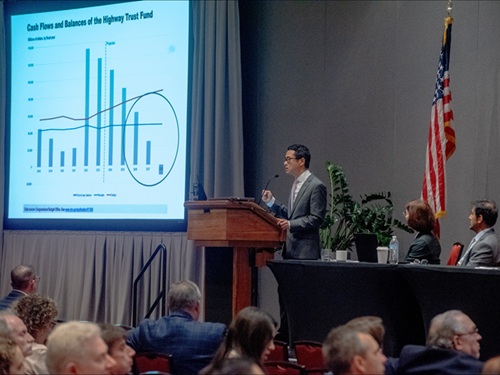
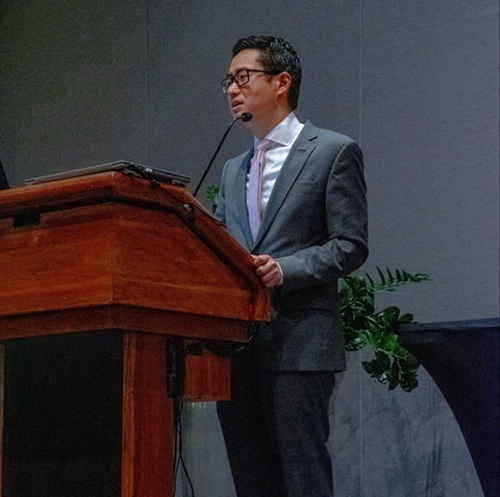
Joung Lee (above) – deputy director-chief policy officer for the American Association of State Highway and Transportation Officials – recently discussed key aspects of current surface transportation reauthorization legislation being debated in Congress during his keynote speech at the National Conference of the American Society of Highway Engineers May 27-28 in Bethesda, MD.
[Above photo by AASHTO]
In his remarks, Lee stressed that over the last 25 years, Congress has increasingly supported surface transportation funding needs from outside “traditional” revenue sources, such as federal taxes on gasoline and diesel fuels.
“Since 2001, Congress has spent more from the Highway Trust Fund [HTF] than revenue it collected,” Lee said. “Since 2008, Congress has transferred $275 billion into the HTF from the General Fund, with the Infrastructure Investment and Jobs Act or IIJA requiring a $118 billion General Fund transfer to the HTF transfer to support spending levels.
Additionally, within the same law, Congress provided another $184 billion in advance General Fund appropriations – an unusual emergency spending designation.”
The need to allocate more funding is partially in response to the rapid increase in infrastructure construction costs that have occurred over the last several years, he said.
For example, Russell McMurry – AASHTO president and commissioner of the Georgia Department of Transportation – noted in testimony before the Senate Committee on Environment and Public Works in February 2025 that inflation between 2021 and 2025 resulted in major cost increases for the materials required to build safe and resilient transportation infrastructure; costs that need to be accounted for in the next surface reauthorization bill.
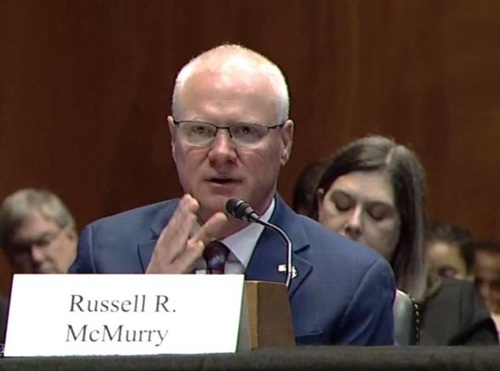
“Georgia, like most every state, has experienced significant cost increases that has eroded the buying power expected from the IIJA,” McMurry noted at the time. “In Georgia, we’ve seen a 60 percent increase in bridge costs, a 66 percent increase in resurfacing costs, and an over 115 percent increase in the cost of [road] widening-type projects.”
Lee echoed that perspective in his remarks, highlighting a 70 percent spike in the National Highway Construction Index tracked by the Federal Highway Administration during the years when the IIJA has been in effect.
He also noted that the proposed reauthorization bill passed by the House of Representatives Transportation and Infrastructure Committee on May 22 also looks to refocus on formula funding versus discretionary grants compared to the IIJA.
Lee added that, given this high-inflation environment, “it matters even more than before” to ensure every dollar of federal investment is quickly translated into tangible projects that benefit communities and states.
Lee concluded by emphasizing that AASHTO’s foremost policy priority right now “is to make sure we can get a new five-year transportation bill that best supports state DOT needs” come October 2026 when the current reauthorization package contained within the IIJA expires.
 Nation
Podcast: State DOTs and the Future of EV Charging
July 24, 2026 Nation
