


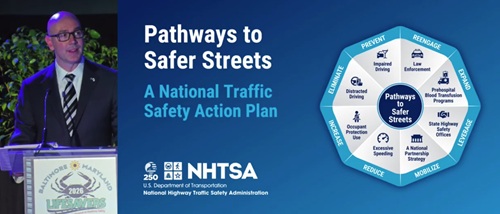
The National Highway Traffic Safety Administration has unveiled a new initiative – entitled Pathways to Safer Streets (P2SS): A National Traffic Safety Action Plan – centered on eight strategies aimed at reducing traffic fatalities.
[Above photo by NHTSA]
NHTSA noted in a statement that the strategies within the P2SS plan target the leading causes of traffic fatalities: impairment, speeding, distraction, and lack of seat belt use.
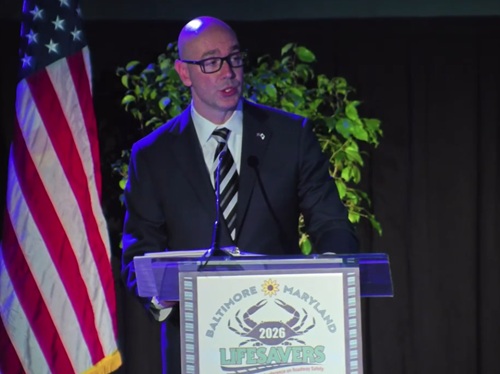
“Our most recent data show a steepening decrease in overall traffic fatalities. That is progress … but progress is not the same as success,” noted Jonathan Morrison, NHTSA administrator, during an April 19 speech at the Lifesavers Conference on Roadway Safety in Baltimore.
“Tens of thousands of lives are still lost every year,” he explained. “And as long as that number is anything other than zero, we cannot call this system safe, we can only call it improved.”
That is why NHTSA has developed the P2SS plan, he said. “To reach our goal of zero deaths, we have to be willing to change the way we do business,” Morrison explained. “We have to break down the silos that have traditionally kept us apart, because while each of your individual missions are critically important, right now, too often, we are operating like separate lanes of traffic when we could be more effective functioning as a single coordinated system.”
The eight specific P2SS strategies NHTSA plans to deploy are:
- Re-engaging law enforcement by restoring grants, expanding partnerships, and launching new awards to honor “local heroes.” The agency is also organizing a law enforcement summit to better align federal and local traffic enforcement efforts.
- To end the cycle of recidivism, NHTSA is assisting states to create impaired driving tracking systems and is encouraging expanded use of ignition interlock devices. The agency is also expanding toxicology support to all 50 states and advocating for oral fluid testing devices to help detect the presence of drugs in drivers.
- As nearly 50 percent of vehicle occupant fatalities occur for those not wearing seatbelts, NHTSA is promoting the “Rural High Five” program to target low-use areas and pushing for more nighttime belt enforcement. The agency is also partnering with the U.S. Army and Air Force to increase the proper installation of child car seats.
- NHTSA plans to prioritize enforcement efforts against motorists driving excessively fast. The agency is increasing support for heavy fines, jail time, and the exploration of intelligent speed assistance devices for repeat offenders.
- NHTSA is doubling down on enforcement efforts to curb distracted driving and is currently researching how the availability of mobile telematics data can be used to identify and address trends on distraction, as well as other risky behaviors such as speeding, swerving, and hard braking.
- Research shows that pre-hospital blood transfusions decrease mortality for trauma patients with severe bleeding by 37 percent. As a result, NHTSA and the U.S. Department of Transportation aim to invest $80 million to expand blood transfusion capabilities. The next round of the USDOT’s “Safe Streets and Roads for All” grants are available for additional funding of prehospital blood programs.
- NHTSA is expanding its reach by engaging with the Department of War, National Park Service, Indian Health Service, and a number of safety organizations to expand the reach of safety messaging, delivering new safety education campaigns to service members, park visitors, and tribal nations. The agency is also encouraging strong collaboration with states to improve safety among the driving public.
- NHTSA plans to boost support for State Highway Safety Offices by creating tools and resources to support their safety programs including development of the State Program Hub – an artificial intelligence or AI-powered platform that provides evidence-based recommendations – that will provide “data deep dives” to help states maximize the impact of safety grants.
NHTSA is also launching the “Promising Practices Repository” – a centralized collection of innovative programs to help states learn the latest lifesaving ideas from one another.
“Pathways to Safer Streets is our roadmap to reaching our traffic safety destination, and we hope that you’ll all join us on our journey,” Morrison stressed. “These pathways are not separate initiatives, but intersecting pieces of the same system. And each pathway depends on the others to work.”
 Nation
AASHTO’s Tymon Talks Value of Interstates at I-70 Event
August 21, 2026 Nation
