


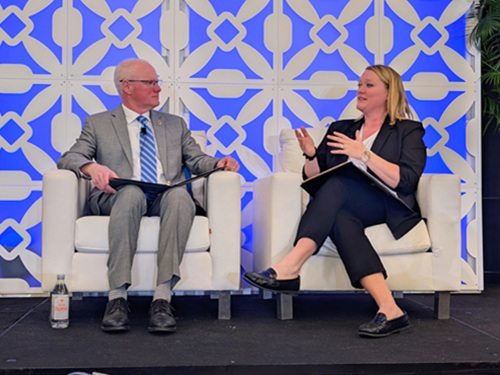
Katherine Scarlett (above at right), chair of the White House Council on Environmental Quality or CEQ, recently shared thoughts on the future of permitting reform as it relates to the National Environmental Policy Act or NEPA on February 25 at the American Association of State Highway and Transportation Officials 2026 Washington Briefing in Washington, D.C.
[Above photo by AASHTO]
“NEPA plays a significant role in the efficient build out of transportation from the construction of highways, bridges, and railroads to waterways and airports. It affects every single American,” she explained during a luncheon speech on February 25 at AASHTO’s Washington Briefing.
“Unfortunately, burdensome permitting and environmental review processes can delay or derail these important infrastructure projects, and in doing so, hold back the growth of the U.S. economy,” she said. “But there’s good news as the [Trump] administration has taken bold action to reduce regulatory burdens and ensure that the American people are not set back by bureaucratic hurdles.”
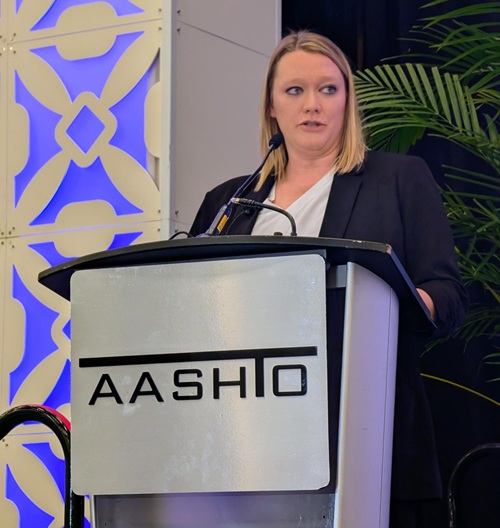
Scarlett pointed to “several decisive actions” taken by the administration to address long standing challenges to the federal environmental review and permitting process – “cutting through the red tape that creates infrastructure delays,” she explained.
Specifically, she pointed the interim final rule published by CEQ in February 2025 that removed its NEPA regulatory implementation structure – a rule that became finalized in January this year.
“NEPA is now being returned to its procedural nature as intended by Congress when passed into law in 1970,” Scarlett said.
“Many key agencies in the executive branch, including the U.S. Department of Transportation, issued revised NEPA implementing procedures [and] the impact we’ve seen has been huge,” she noted. “[They] implement deadlines and page limits for environmental reviews [and] provide clarification that NEPA does not apply to every single action a federal agency takes, but only to federal actions where the agency has substantial control and discretion to take environmental effects into account. They also ensure simple and expeditious processes to create categorical exclusions.”
Going forward, Scarlett said CEQ will work to minimize repetitive NEPA analysis among federal agencies – including USDOT modal administrations – so they focus their attention on actions with “truly significant” environmental effects.
“Through interagency coordination and guidance, CEQ is focused on facilitating meaningful permitting reform by streamlining and/or removing outdated procedures, enhancing certainty and efficiency,” she said. “We’re continuing to work with other agencies across the executive branch to revise their NEPA implementing procedures, but we’ve already made great progress in just one year.”
Scarlett also said that technology is taking “center stage” within permitting reform conversations among federal agencies.
“The White House has taken steps to incorporate technological innovations that speed up and simplify federal environmental review processes to modernize federal environmental reviews for infrastructure projects,” she noted.
“The plan provides a government-wide strategy to effectively and efficiently evaluate environmental reviews and permits, allowing for seamless information exchange between agencies, simplified interactions for applicants, and greater transparency and predictability on environmental reviews and permitting schedules for sponsors and stakeholders,” Scarlett stressed.
“We have three years to really implement these new procedures in this new land of NEPA,” she added. “As we move forward, we will remain focused on driving meaningful NEPA reform through implementation to reduce the delays in federal permitting.”
 Nation
AASHTO Safety Summit: Engaging the Public in Safety
October 2, 2026 Nation
