


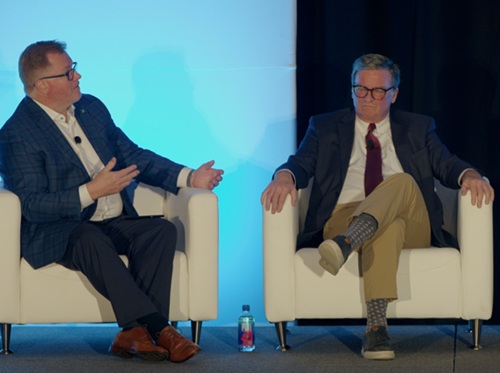
The American Association of State Highway and Transportation Officials recently hosted a knowledge session at its 2026 Spring Meeting in Savannah, GA, about the multimodal strategies states are deploying to help move an influx of visitors to the U.S. for the FIFA 2026 World Cup soccer matches this summer.
[Above photo by AASHTO]
Tim Schock, VP of smart mobility business for Parsons – the session’s presenter – moderated a panel discussion consisting of Mike Carroll, secretary of the Pennsylvania Department of Transportation; Julie Meredith, secretary of the Washington State Department of Transportation; John Hibbard, deputy chief engineer for the Georgia Department of Transportation; and Miles Bolin, deputy director of the Office of Public Liaison at the U.S. Department of Transportation.
Schock emphasized that the sheer scale of the World Cup provides a host of challenges, noting that it features “the largest global television audience for any event, anywhere; larger than the Olympics, larger than the Super Bowl. In total, roughly half the world will be watching the World Cup final. So it poses the ultimate test of moving fans that are coming to our shores, to help move those people, and transport those people around our host cities effectively and efficiently as well as sustainably.”
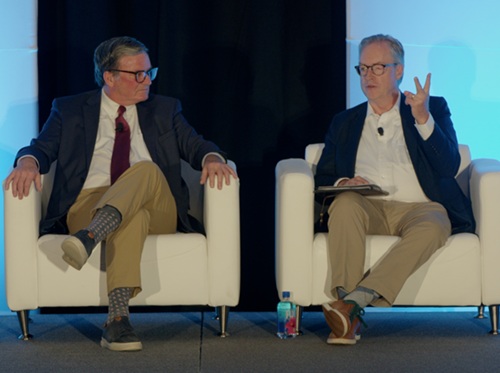
Yet PennDOT’s Carroll emphasized that, on the ground, the demands of handling an influx of visitors for World Cup matches ultimately poses nothing out of the ordinary in comparison to other large-scale events state departments of transportation routinely manage in their regions.
“These are really not novel or new; we’ve had huge events like this, namely the pope coming to Philadelphia, a Super Bowl parade, and others,” he said. “Not only have we had sporting events galore, we have to manage them around the daily activities of our folks that live southeastern Pennsylvania [and] the economic hub of the Port of Philadelphia and our airport. But it really highlights again, for those that need to be reminded, that a robust transit system in urban centers is critical. It’s actually critical in rural areas as well, but for different reasons. But our transit system will be put to the test.”
In many ways, he said the actual World Cup games are less concerning for him than the “Fan Fest” components to those matches. “The nuances of how many folks are going to show up at a fan fest, and when do they come and how long are they going to stay – that is a lot more nebulous than the actual game that occurs on a certain date time, and location,” Carroll noted. “Finally, for me, the wild cards would be some sort of catastrophic event unrelated to the games or because of the games. But we have contingency plans in place for such things.”
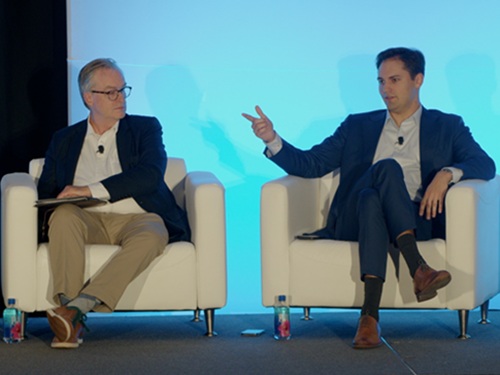
WSDOT’s Meredith emphasized Carroll’s point that “life goes on during these games, so part of what we are doing is making sure people know there is more than one way to get around our cities; that they ‘know before they go’ via mobile applications and other information channels.”
She stressed that social media assets will be critical to that communication effort. “We need to be on all the spaces where people are so we can communicate and they get the information they need to know,” Meredith noted. “That is all part of the overall planning – and we’ve done it all before, so we are reusing models we have developed in the past to manage this.”
Georgia DOT’s Hibbard noted that one major challenge will be the lack of familiarity many visitors will have with cities, such as Atlanta, where World Cup games will be played.
“They are not from around here and will be coming to the stadium from all around. So much of our planning is based on them attending games but not in the ‘traditional way’ typical fans visiting our city do,” he explained.
“That requires us to be nimble and we cannot do it without our private-sector partners,” Hibbard noted. “We certainly have a strong relationship with them and they will help us put our best foot forward so all the visitors come away from this experience feeling they had a good time and felt safe.”
In the end, USDOT’s Bolin said in many ways the best outcome from this experience can be summed up in one word: “nothing.”
“I certainly expect we’ll pick up a lot of best practices from this event, especially as we’ll have lot of other major events – such as America’s 250 celebrations – taking place simultaneously, as well as the [transportation] demands of daily life,” he explained. “But, in many ways, it would be a great result if no one talks about transportation for the World Cup; if it just happens and it is not making headlines.”
 Nation
AASHTO Offers FHWA Performance Management Insights
October 23, 2026 Nation
