


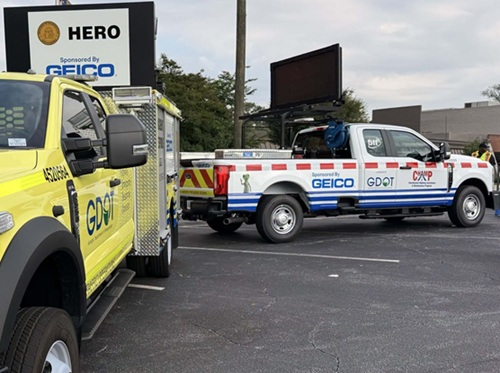
Across the country, state departments of transportation provided support for the annual Crash Responder Safety Week outreach campaign to remind motorists of the key role they play in protecting the people who respond to and clear traffic incidents from the nation’s roadways – including emergency responders, law enforcement personnel, tow and recovery operators, and highway workers.
[Above photo by Georgia DOT]
According to the Emergency Responder Safety Institute (ERSI), at least 26 first responders across the country have been struck and killed while responding to traffic incidents in 2026 alone. In an average year, ERSI reports one responder is killed nearly every week.

“Every day, first responders and roadway assistance personnel put themselves in harm’s way to help others, often just feet from moving traffic,” stressed Russell McMurry, president of the American Association of State Highway and Transportation Officials and commissioner of the Georgia Department of Transportation.
“Whether it’s a law enforcement officer, firefighter, tow truck operator or any first responder, these dedicated men and women deserve to return home safely at the end of every shift,” he emphasized.
“We all have a responsibility to protect those who work along our roadways,” he added. “Slowing down, moving over and remaining alert are simple actions that can mean the difference between life and death. We urge every motorist to make that commitment, not just during Crash Responder Safety Week, but every time they get behind the wheel.”
[Editor’s note: Dina El-Tawansy, director of the California Department of Transportation, emphasized those same roadway safety issues in the video below.]
Started as a national initiative sponsored by the Federal Highway Administration in 2016, Crash Responder Safety Week adopted the theme of “Slow Down, Move Over, Lives are on the Line” for the 2026 campaign, conducted November 2-6 this year.
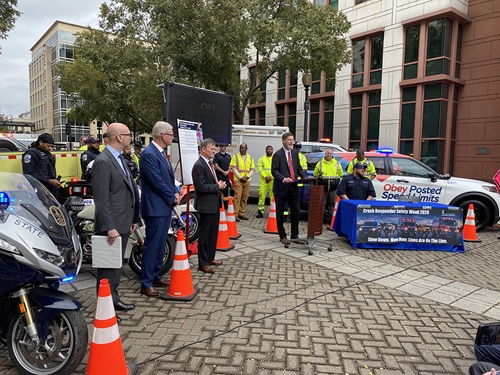
The U.S. Transportation Department hosted a Crash Responder Safety Week 2026 event at its headquarters in Washington, D.C., during the week of November 2 to underscore the importance of partnering with law enforcement and first responders to reduce roadway injuries and fatalities.
During that event, the Federal Highway Administration highlighted its Traffic Incident Management or TIM training initiative, which teaches police, firefighters, highway workers, emergency medical services, and towing personnel best practices for safe, coordinated crash response, quick scene clearance, improved communication, and ways to prevent secondary crashes. More than 930,000 responders have completed TIM responder training to date, the agency said.
State DOTs – including the Georgia DOT, the Virginia Department of Transportation, the New Jersey Department of Transportation, the Kentucky Transportation Cabinet, the Wisconsin Department of Transportation, the Nevada Department of Transportation, the Arizona Department of Transportation, the Delaware Department of Transportation, and many others – provided a wide array of support for this yearly campaign.
“First responders have a very small space to work in when responding to a crash,” explained Torey Keltner, traffic services program manager for the Hawaii Department of Transportation, in a statement. “It’s critical for the public to follow the law … [and] we sincerely appreciate the community’s support in helping keep responders safe by slowing down and moving over.”
[Editor’s note: The Utah Department of Transportation released the video below to highlight the critical and often dangerous work performed by its Incident Management Teams on roadways in the southern part of the state.]
Becky Allmeroth, chief safety and operations officer for the Missouri Department of Transportation, added that Crash Responder Safety Week serves as a reminder that “protecting those who protect us is a shared responsibility,” encouraging motorists to remain alert, avoid distractions, and give responders the space they need to work safely.
“Every time a responder steps out onto the roadway, they are putting their safety in the hands of passing motorists,” she said in a statement. “These are people working to help someone in need, clear a crash or restore traffic flow, and they deserve to return home safely at the end of their shift. Pay attention, slow down, and move over when approaching emergency vehicles. A few seconds of caution can make a life-saving difference.”
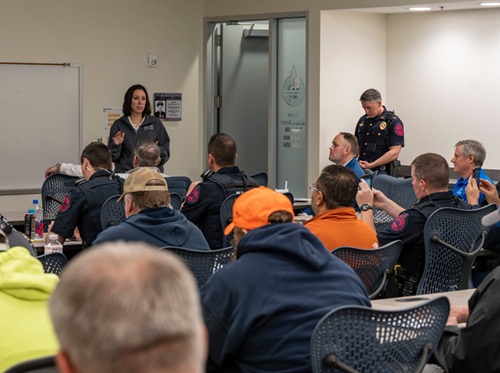
Garrett Eucalitto, commissioner of the Connecticut Department of Transportation and immediate past president of AASHTO, pointed out that, annually in Connecticut, there are more than 100,000 motor vehicle crashes where responders work close to oncoming traffic.
Nationwide, more than 160 crash responders have been killed in the line of duty since 2020, he stressed – figures that underscore the risks responders face while assisting motorists and the importance of driver awareness around roadside incidents.
“Every driver has the responsibility to help make Connecticut’s roadways safer, including when passing a vehicle stopped along the roadside,” Eucalitto emphasized in a statement. “We encourage drivers to make [such] precautions part of their every drive.”
“It’s vital that drivers slow down and get over when they see a traffic incident ahead,” explained Vicki Kramer, director of the Nebraska Department of Transportation, in a statement. “The people working just feet from moving traffic are counting on drivers to pay attention and give them the space they need to do their jobs as safely and efficiently as possible. Taking a few extra seconds to slow down and move over can make the difference between a responder going home safely and a tragedy.”
 Top Stories
Mid-Terms: Democrats Will Control Congress in 2027
November 6, 2026 Top Stories
