


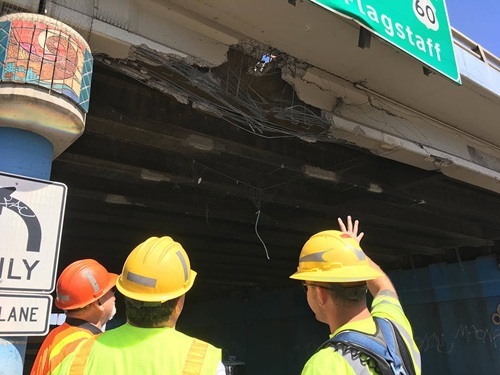
Across the country this week, a host of state departments of transportation participated in national “Bridge Strike Awareness” campaign.
[Above photo by the Arizona DOT]
The “Check Your Height, Know It’s Right” campaign encouraged people to check that their vehicle is not too tall to safely fit under bridges that extend over state and local roadways. Such overhead collisions, commonly known as “bridge strikes,” not only damage vehicles and infrastructure but also cause delays and put the public and emergency responders at risk. The campaign focused on all classes of drivers, passenger car motorists as well as commercial vehicle operators, as well those driving delivery and moving box-type trucks, as well as recreational vehicles.
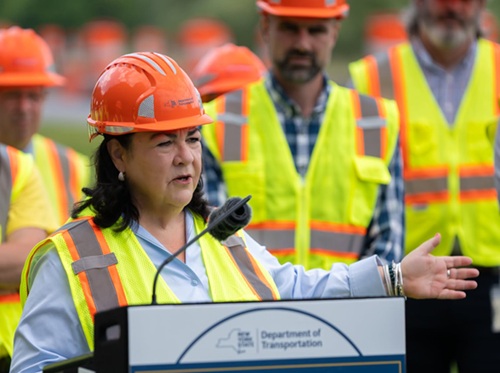
In November 2023, the New York State Department of Transportation launched the first “Check Your Height, Know It’s Right!” social media and video campaign to educate the public about the importance of preventing bridge strikes. Since then, NYSDOT has worked with The Eastern Transportation Coalition and the American Association of State Highway and Transportation Officials to encourage other states to adopt the campaign. For the 2026 campaign, 26 states – including Washington, D.C. – participated, up from 16 states in 2025.
“NYSDOT’s number one priority is the safety of the travelling public – including doing all we can to prevent bridge strikes,” said Marie Therese Dominguez, NYSDOT’s commissioner, in a statement. “The ‘Check Your Height, Know It’s Right!’ continues to gain momentum with states from Maine to Hawaii joining the effort.”
“Avoiding bridge strikes is a shared responsibility. Drivers must know the height of their vehicles and remain alert for posted bridge heights,” explained Russell McMurry, president of the American Association of State Highway and Transportation officials and commissioner of the Georgia Department of Transportation.
“At the same time, our department has a responsibility to ensure bridge-height signage is visible, clear and easily identifiable,” he said in a statement. “By working together, we can help prevent bridge strikes and eliminate the significant costs, traffic disruptions and safety risks they create for the public, first responders and our employees.”
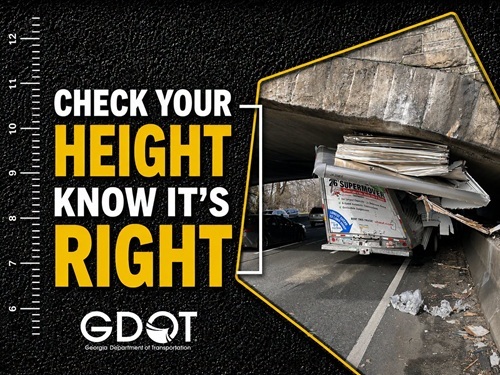
[Editor’s note: Georgia DOT also supported the bridge strike awareness campaign via an episode of its “Ahead of the Curve” podcast and its Extra Mile Blog. ]
“Knowing your vehicle’s total height is just as important as knowing where you are going,” said George Conner, deputy director of operations for the Alabama Department of Transportation, in a statement.
“Before getting behind the wheel, drivers should check the height of the vehicle and its load, plan the route carefully and pay close attention to posted clearance signs,” he noted. “A quick check before a trip can prevent a dangerous crash and hours of disruption for everyone on the road.”
A key aspect of the campaign emphasized that navigation devices and related mobile applications do not display bridge heights.
“While GPS apps are helpful navigation tools, they do not know the type of vehicle you’re driving and don’t flag potential low bridge issues,” stressed Garrett Eucalitto, immediate past president of AASHTO and commissioner of the Connecticut Department of Transportation. “Before every trip, take a moment to check your vehicle’s height and know it’s right.”
He noted in a statement that, across Connecticut alone, there are more than 700 low bridges under 14 feet-6 inches in height, including on the Merritt Parkway, where trucks are prohibited, as well as throughout key railroad corridors statewide.
“A navigation device can map the route, but only a driver knows if their vehicle will safely travel under bridges along the way,” echoed Rebecca Goodman, secretary of the Kentucky Transportation Cabinet, in a statement. “Watch for posted clearance signs. If there’s any doubt, don’t guess; pull over and check. Those couple of extra minutes can save hours of cleanup and thousands of dollars in damage.”
“Drivers often rely on noncommercial mobile GPS mapping tools to choose their routes and to provide directions. But those GPS tools are not designed to be used with non-passenger vehicles, including rented box trucks, RVs, and especially oversize commercial vehicles, emphasized Tim Gatz, secretary of the Oklahoma Department of Transportation, in a statement. “They do not flag potential low bridges.”
The Arizona Department of Transportation noted in a statement that the costs to repair damage to highway infrastructure due to bridge strikes can add up quickly. During the last two fiscal years, the agency said its Insurance Recovery Team processed 14 bridge strike claims and recouped nearly $2.9 million from individuals or insurance firms responsible for damage to the highway system.
Arizona DOT added that national crash data shows that drivers may not always consider vehicle height and related restrictions during operation. For example, a typical 26-foot moving truck may have a height ranging from 11 feet to 13 feet and 6 inches or taller, the agency said.
“Kansas DOT and local public works offices have made investments to build and maintain bridges on our state’s transportation system,” noted Calvin Reed, secretary of the Kansas Department of Transportation. “Repairing damaged structures can be costly and time consuming.”
He stressed in a statement that Kansas data shows that nine people were killed and 138 injured in bridge strike crashes on state and local roadways in 2025; crashes that, again, can also cause serious structural damage that may lead to road closures and impact emergency responders and other motorists.
“For taller vehicles, make sure you check your height before you leave, and always buckle up and avoid distractions,” he emphasized. “Hitting a stationary structure while traveling at any speed could have devastating consequences.”
 Nation
FAA Issues $481M to Help Improve Airport Infrastructure
September 11, 2026 Nation
