


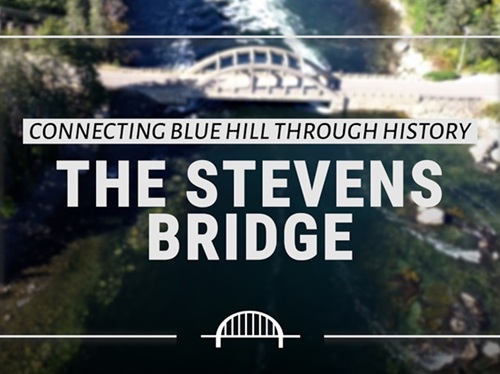
The Maine Department of Transportation recently released a 30-minute documentary film entitled “Connecting Blue Hill Through History: The Stevens Bridge,” that explores the history of the Blue Hill area through the lens of the ever-changing Stevens Bridge.
[Above image by Maine DOT]
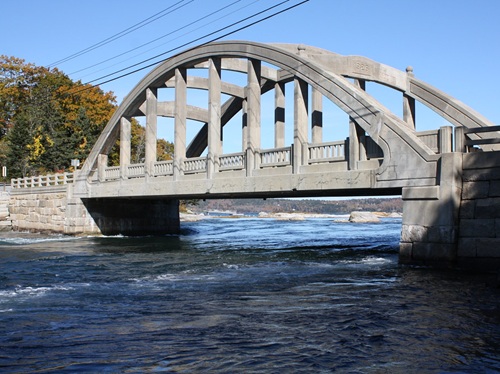
Constructed in 1926 as a reinforced concrete tied arch, the Stevens Bridge – also known locally as the Falls Bridge – became both a vital crossing and an iconic community landmark for nearly a century. This documentary film explains how changing safety standards, structural concerns, and modern transportation demands ultimately led to the decision to replace the historic bridge, while also acknowledging the community’s deep attachment to its distinctive form and setting.
“‘Connecting Blue Hill Through History’ underscores how a single bridge can carry generations of meaning,” said Julie Senk, Maine DOT’s historic preservation coordinator, in a statement. “By weaving together personal memories, engineering history, and cultural perspectives, this film helps us better understand the connections between people, places, and the transportation systems that serve them.”
Maine DOT produced this documentary in fulfillment of a mitigation commitment made to the Federal Highway Administration during the planning stages; to create a lasting record of the Stevens Bridge due to the historical significance of the structure and the surrounding environment.
The film also recognizes the enduring presence and perspectives of indigenous communities whose relationships to the land and waters of this region long predate modern infrastructure projects.
By situating the story of the Stevens Bridge within this broader context, Maine DOT said the documentary encourages viewers to consider how infrastructure decisions intersect with cultural heritage, traditional homelands, and long-standing stewardship of rivers and coastal areas.
“Projects like the Stevens Bridge remind us that transportation is about more than moving people and goods. It’s about connecting communities across time,” said Andy Lathe, Maine DOT project manager. “As we plan for the future, we also have a responsibility to recognize and respect the stories, values, and history tied to the places we work in.”
Many state departments of transportation have engaged in similar documentary film work.
For example, the New Hampshire Department of Transportation is hosting a special viewing of three short documentary videos highlighting the history, engineering, and significance of New Hampshire’s historic bascule bridges on August 18.
The agency said in a statement that it produced those videos as part of the mitigation efforts associated with the replacement of the 1949 Neil R. Underwood Memorial Bridge and, together, they tell the story of New Hampshire’s movable bridges and their important role in the state’s transportation and maritime history.
And in September 2024, the Iowa Department of Transportation – with support from the Wisconsin Department of Transportation and the Federal Highway Administration – released a 25-minute film about the Black Hawk Bridge and that of the local communities surrounding it.
Created as a compliance requirement with the National Historic Preservation Act, the short film – entitled “Bridging Generations: The Story of the Black Hawk Bridge” – details the history of the 1,700-foot bridge that spans the Mississippi River, connecting Iowa Highway 9 in Lansing, IA, to Wisconsin Highway 82 in rural Crawford County.
 States
Alabama Finalizes Mobile Bridge and Bayway Financing
September 25, 2026 States
