


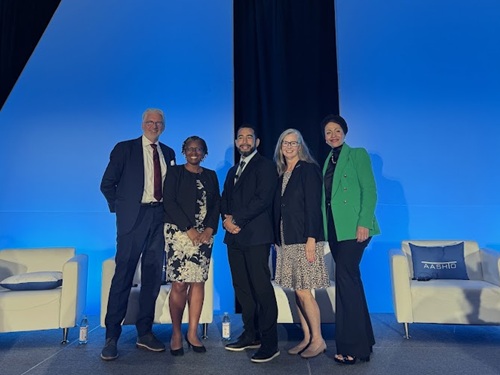
The American Association of State Highway and Transportation Officials recently hosted a knowledge session at its 2026 Spring Meeting in Savannah, GA, detailing how state departments of transportation are working to make the project delivery process more efficient.
[Above photo by AASHTO]
David Armstrong, senior director of business consulting for Bentley Systems – the session’s presenter – moderated a panel discussion that featured Shanté Hastings, secretary of the Delaware Department of Transportation; Manuel Maestas, chief engineer for the New Mexico Department of Transportation; Dawn Sullivan, deputy director of the Oklahoma Department of Transportation; and Gehan Elsayed, chief engineer for the West Virginia Department of Transportation.
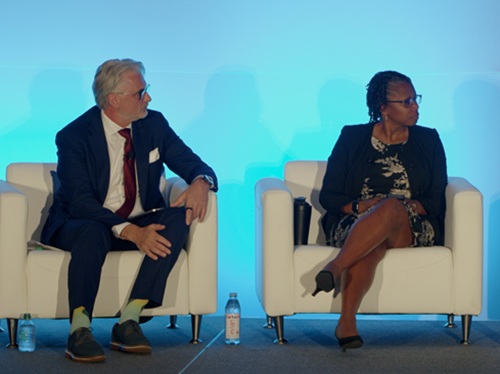
“There’s really a growing expectation – whether it be from our leadership within our state, our partners, and obviously the community – that we’re making the most of every dollar and demonstrating real measurable value,” Delaware DOT’s Hasting explained. “That’s been a major driver behind our shift toward digital delivery. Over the past several years, we’ve been on a deliberate journey to modernize how we plan, design, and deliver projects – moving away from kind of traditional ‘static’ set of paper plan sets to more three-dimensional [3D] model-based approaches.”
She noted that her agency has started this “journey” by piloting a variety of digital planning concepts, such as creating 3D project models and then giving them to contractors in easy-to-use formats to support the construction of projects.
“Some of those efforts have been successful and some taught us things not to do in the long term,” Hastings said. “That’s led us to develop things like modeling standards, item type data structures, and this year, creating a formal digital delivery roadmap to ensure that we are consistent and useful across the board. We’ve also been investing in better tools and workflows, and that’s really important, whether in improving and reviewing our modeling, incorporating shock processes, or piloting mobile and cloud-based platforms to support construction and field staff. We want to learn and grow; testing, learning, and refining our approach to digital [project] delivery based on real world feedback.
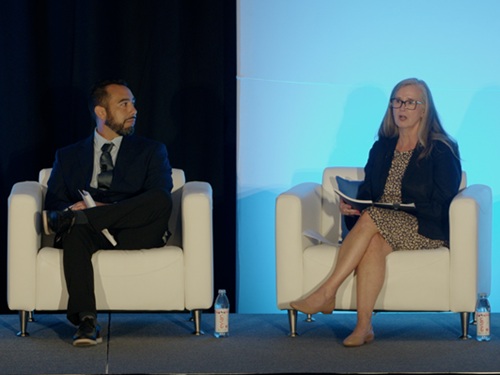
NMDOT’s Maestas said getting into the world of digital delivery has “opened our eyes” to a lot of “enormous” possibilities.
“It goes from design planning all the way to post-construction and the ‘as-built’ environment. It made us realize that we can have one source of truth, if you will, where everybody can go and pull out just the data they need for a particular project – and know it’s the most updated data available,” he explained. “What we’re kind of striving for is to have that central, platform that everybody can utilize without having to use a lot of time to do the research and see where things are at. I mean, we have the data. We just need to be able to get it to everybody. That’s the trick.”
WVDOT’s Elsayed noted that this growing focus on data and digital delivery is also enhancing and, in some cases, shifting the broader strategic focus of state departments of transportation like hers.
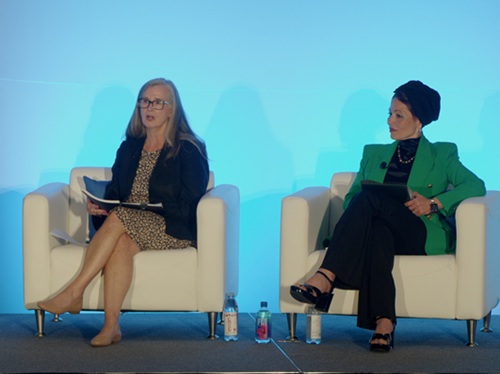
“So, we had a shift in the mindset on how we’re approaching our overall asset program,” she explained. “Historically, we managed pretty much everything on a project-by-project basis. But we’re moving now to shifting toward program performance. So, we’re no longer viewing projects in isolation, but part of a whole, broader system.”
That means integrating planning, construction, maintenance, plus project selection and delivery into one seamless initiative.
“We’ve seen the biggest gains in integrating the data workflow and decision making across the entire project life cycle,” Elsayed noted. “So, what we’ve been doing and seeing a lot of success in is leveraging the data and technology to integrate all of this. For example, we’ve been modernizing our asset management systems – particularly for bridge and pavement management systems – and how we can leverage available technology to help us make better project management and delivery decisions.”
However, Oklahoma DOT’s Sullivan stressed that shifting into the “digital delivery world” also required major changes to the underlaying work culture of her agency.
“The evolution of digital delivery showed us we were stuck – that we’d been doing the same thing the same way for 20 years,” she explained. “We collected data, sure, but that data lived in silos. Everybody had their data and it was their data – nobody else could have it; nobody could touch it. Basically, it was like, if somebody invented a wheel, I’m not going to use that wheel because it’s not as good as the wheel that I can make.”
Thus, that led Oklahoma DOT to “reimagine” what a modern state department of transportation should look like. “So, we developed cross-functional teams and established internal champions to help us become more collaborative; to help us become more forward leaning, more focused on data governance,” Sullivan emphasized.
“We recognized that data is a huge asset and that it needs that single point of truth for all the decisions that we’re going to make with it because we have limited resources,” she said. “So, through that modernization initiative, it ended up being what I would call transformative. We tried some things, maybe we didn’t accomplish everything that the vision had, but we’ve made so many huge strides. And I say the key takeaways from that effort was we focused on collaboration, innovation, change management, communication, customer service, efficiency, and adaptability.”
 Nation
Air Taxi Demonstration Conducted at Texas Airport
September 18, 2026 Nation
