


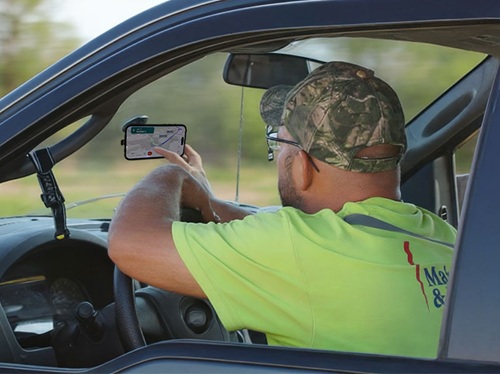
A new study by the Insurance Institute for Highway Safety drawing on telematics data indicates that far more motorists are using cellphones in the lead-up to crashes than is reflected in police crash reports.
[Above photo via IIHS]
The data – collected from safe-driving mobile applications in which motorists voluntarily enroll – show that cellphone use prior to vehicle crashes is undercounted in police reports by a factor of at least seven, noted David Harkey, president of IIHS.

“It’s widely accepted that police reports often fail to capture the role of cellphones in crashes. Many smartphone functions are hard for a witness to see, and drivers are reluctant to admit being distracted,” he said in a statement. “Telematics are allowing us to understand the true magnitude of the problem.”
IIHS researchers examined anonymized cellphone data from Cambridge Mobile Telematics (CMT) for the study and found that drivers enrolled in safe-driving programs that rely on the CMT platform were using their cellphones in the 30 seconds prior to impact in 7 percent of single-vehicle crashes and 8 percent of two-vehicle crashes. Meanwhile, police reports for those same crashes recorded cellphone use in less than 1 percent of them.
Those numbers include drivers whose screens were unlocked for any reason, including navigation. However, telematics data show the problem of undercounting is nearly as severe when only physical manipulation of the phone and hand-held and hands-free calls are considered, IIHS noted.
IIHS stressed that CMT does not track what specific apps are used, while noting its researchers also didn’t have a way to determine whether the cellphone user was considered at fault in the crash or whether distraction caused the incident.
To determine how often smartphone use is overlooked in police reports, IIHS researchers worked with CMT to link crashes recorded by safe-driving apps to police-reported crashes in four states between 2021 and 2024. Since police reports do not always record crash times and locations with perfect precision, crashes that occurred within the same 15-minute window and within the same one-mile radius were determined to be a match. This generated a sample of nearly 17,000 linked crashes.
Along with detecting crashes, CMT’s platform can identify when and how the driver uses their phone. To monitor distraction, the application tracks hand-held calls, hands-free calls, and manipulation or handling of the device while also logging the times when the screen is unlocked for something passive like Google Maps or YouTube, though CMT does not use this measure in its own studies of distraction.
 Nation
AASHTO Offers FHWA Performance Management Insights
October 23, 2026 Nation
