


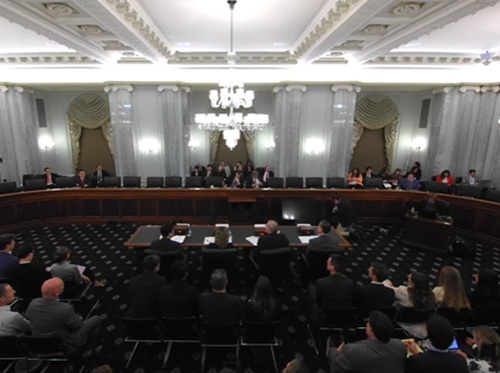
A Senate Commerce, Science, and Transportation Committee hearing on June 9 delved into a variety of technological advances that are helping drive innovation in the transportation sector.
[Above photo by the Senate Commerce Committee]
Chaired by Sen. Todd Young (R-IN), that hearing featured testimony from Ian Jefferies, president and CEO of the Association of American Railroads; Chris Spear, president and CEO of the American Trucking Associations; Laura Chace, president and CEO of the Intelligent Transportation Society of America; and Cole Scandaglia, deputy director of the International Brotherhood of Teamsters.
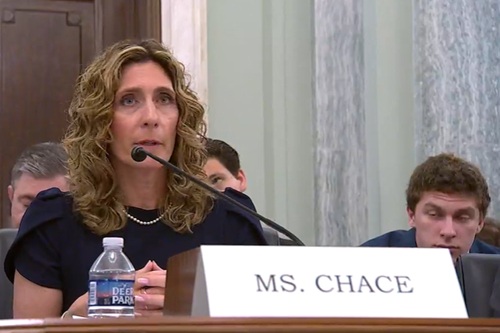
In her testimony, ITS America’s Chace noted that the U.S. transportation system is “evolving from one largely defined by concrete, asphalt, and steel” to one that now includes sensors, software, data, and algorithms.
“Today’s digital networks provide tools to link physical transportation assets with a digital intelligence layer, allowing us to gather, transmit, store, analyze, and communicate information in real time, and to use that information to increase safety, reduce congestion, and enhance mobility for every transportation user,” Chace said.
“Transportation digital infrastructure helps us gather information about our transportation system and infrastructure, providing agencies with crucial tools to make planning decisions, enact safety countermeasures, build and operate their system more effectively and at lower costs, and provide real-time information to drivers and road users,” she noted.
Chace stressed that this is no longer a “theoretical, high-tech future,” rather these technology solutions now being deployed are delivering real outcomes. “Tools like artificial intelligence (AI), vehicle connectivity, automated vehicles (AVs), digital twinning, advanced air mobility, and many other ITS technologies are transforming the way people and goods move,” she said.
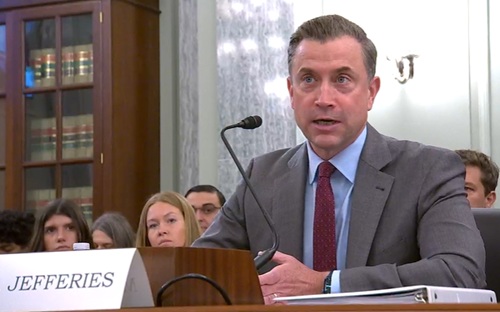
AAR’s Jeffries stressed that a more “modern” federal regulatory framework will be key to delivering the benefits from those technologies.
“To move into the future and develop a modern, effective regulatory framework, policymakers should focus on implementing performance-based regulations that allow the industry to invest in cost-effective, innovative solutions to enhance safety and efficiency,” he said.
“These regulations should be based on verifiable data, sound science, and demonstrated need and should encourage innovation without locking in existing technologies and processes,” Jeffries emphasized. “Regulators should also strive to improve transparency throughout the regulatory process, including meaningful discussions with all stakeholders, robust benefit cost analysis that considers the cumulative burden of regulations, and guidance documents that clarify ambiguous regulations rather than creating new obligations or coercing compliance.”
That also means removing outdated regulations as well, added ATA’s Spear.
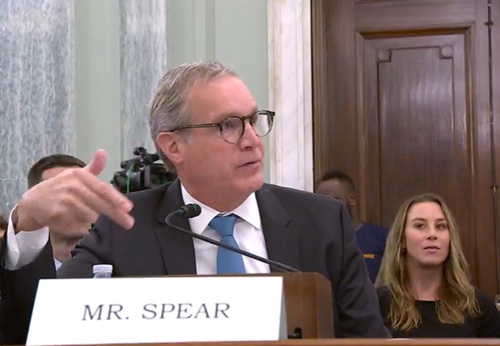
“Regulated entities, including motor carriers, rely on thoughtful, well-written, and safety-driven federal regulations and guidance to ensure the utmost safety for commercial drivers and all who share the road,” he said.
“However, we recognize that certain federal rules and regulations that affect the trucking industry are redundant, outdated, or place undue burden on members of the trucking industry – in some cases, invoking compliance merely for compliance’s sake rather than a material benefit to the industry or national interest,” Spear noted.
He said ATA applauds efforts to swiftly review and take deregulatory action to remove unnecessary or outdated red tape and regulatory burdens all while promoting industry efficiency without undermining safety.
ITS America’s Chace added that, as the pace of technology innovation continues to accelerate, coordinated federal leadership is vitally needed.
“Whether it’s through setting strategic priorities and frameworks, providing financial incentives, or breaking down certain institutional barriers, the federal government has an important role to play,” Chace said. “Strong federal leadership can unlock a scaled domestic marketplace, support American innovation, and strengthen our competitive position globally – particularly as countries like China move aggressively to integrate technology into their transportation systems as a matter of national strategy.”
That federal leadership is critical, she stressed, as it can simultaneously provide important cybersecurity, privacy, and general policy safeguards to help ensure emerging technologies are deployed in a way that maximizes their public good.
“The private sector is ready, and the technology is ready,” Chace said. “The question is whether federal policy will treat it with the urgency and importance it deserves.”
 Top Stories
State DOTs to See Benefits from Permitting Reform Bill
October 16, 2026 Top Stories
