


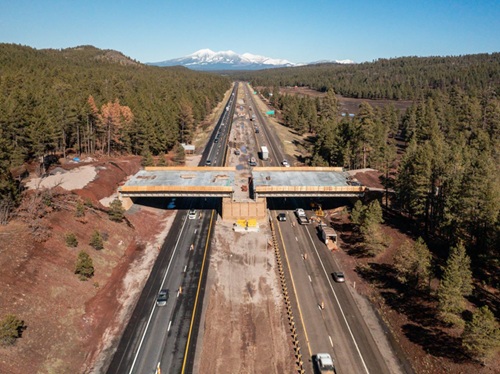
The Arizona Department of Transportation recently noted that construction is more than halfway complete on a I-17 wildlife overpass 12 miles south of Flagstaff.
[Above photo by Arizona DOT]
Work on the $15.8 million wildlife overpass – which will be suspended for the winter season – began in May and is scheduled for completion by fall 2026, the agency said in a statement.
The concrete deck has been poured for the 100-foot-wide bridge, which is designed to allow wildlife – including elk and deer – safely cross over I-17. The overpass ultimately will be topped with soil and native grasses and plants, Arizona DOT said, to help encourage animals to use it.
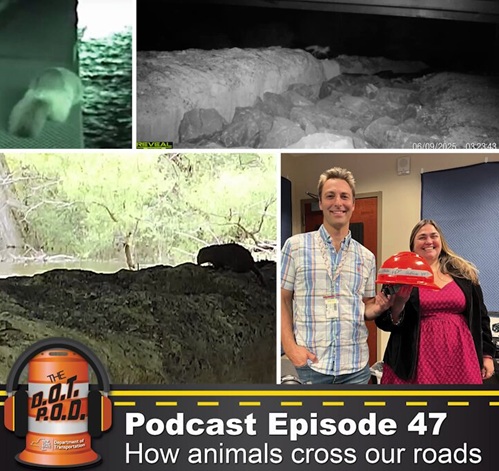
[Editor’s note: A recent episode of “The DOT POD” podcast produced by the New York State Department of Transportation broadly discussed how state departments of transportation are working to provide safer passage for wildlife across highways and roadways.]
In addition to completing the bridge, which is located north of the Willard Springs Road interchange, crews next year will finish the installation of wildlife fencing along eight miles of I-17.
The agency noted that it is partnering with the Arizona Game and Fish Department on the I-17 overpass project in an effort to reduce the risk of vehicle crashes involving animals, especially elk and deer, with most of the funding for the project comes from a grant issued via the Federal Highway Administration’s Wildlife Crossings Pilot Program, Arizona DOT said; a program created by the Infrastructure Investment and Jobs Act or IIJA of 2021.
From 2018 to 2022, the area where the new I-17 overpass and fencing are being added accounted for 58 percent of crashes involving wildlife between Stoneman Lake Road and Flagstaff. And in that 32-mile stretch of I-17, about 75 percent of all reported wildlife crashes involved elk, which can weigh up to 1,100 lbs, Arizona DOT noted.
[Editor’s note: In the video below by the New Mexico Department of Transportation, Chad Loberger with the Arizona Game and Fish Department, explains the role animal crossings play in improving safety for both wildlife and the traveling public.]
Other state DOTs are also engaged in similar efforts. For example, as wildlife-vehicle collisions on I-90 in western Montana pile up, the Montana Department of Transportation is launching a feasibility study for construction of a wildlife undercrossing – one that could also restore the natural flow of a creek to help with fish crossings.
The study area is a 7.3-mile segment of I-90, centered on Sixmile Creek in Missoula County. Home to grizzly bears, black bears, elk, and deer, it is a “key linkage area” for wildlife between the Ninemile Valley and Bitterroot Range, the agency said.
In August, the Colorado Department of Transportation reached the 50 percent completion point for its I-25 Greenland Wildlife Overpass project located between Larkspur and Monument; what will be the world’s largest interstate-spanning bridge structure for wildlife once finished.
In October 2024, the California Department of Transportation issued a Wildlife Connectivity Report that identifies more than 140 locations where roadways can be better integrated with the migration needs of animals statewide.
Meanwhile, the Utah Department of Transportation recently outlined its nearly five-decade effort to mitigate wildlife vehicle collisions statewide in an article in The Leaflet by AASHTO; a newsletter focused on state DOT environmental management issues published by the American Association of State Highway and Transportation Officials.
That long-term effort by Utah DOT also included the recent development of The Utah Roadkill Reporter; a smartphone application introduced in 2022 that gets the public involved in reporting wildlife collisions.
And in November 2023, the Wyoming Department of Transportation completed wildlife crossings built as part of its $15.1 million Dry Piney project. The Dry Piney project – a joint effort between the Wyoming Game and Fish Department and the Wyoming DOT – includes nine underpasses and 16.7 miles of eight-foot-high fencing on both sides of Highway 189 in the western part of the state to protect big game animals, primarily mule deer.
 States
Kansas DOT Helps Host ‘Drive To Zero Day’ Event
March 13, 2026 States
