


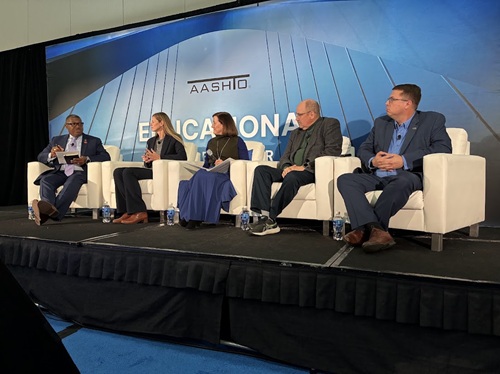
At the American Association of State Highway and Transportation Officials 2026 Annual Meeting in Louisville, KY, a knowledge session examined how state departments of transportation are tapping into a variety of data-driven and technology-based speed management strategies to enhance their safe mobility goals.
[Above photo by AASHTO]
Shawn Wilson, senior vice president and subsector leader for global infrastructure and engineering firm WSP – the session’s presenter – moderated a panel discussion that featured Lyndsay Quist, commissioner of the Indiana Department of Transportation; Katie Thomson, secretary of the Maryland Department of Transportation; Eric Schroeter, deputy director and chief engineer for the Missouri Department of Transportation; and Jason Siwula, deputy state highway engineer for the Kentucky Transportation Cabinet.

INDOT’s Quist said her agency is trying to make “iterative and incremental progress” on the issue of speed management “because there does not seem to be one ‘silver answer’ out there in the safety culture for reducing [roadway] fatalities and serious injuries.” She added that her agency is using multidisciplinary teams to make “each project better” in terms of its safety profile; incorporating different aspects of safety “holistically” in all of INDOT’s projects as well as the everyday work the agency performs.
For example, INDOT is working closely with Purdue University to tap into connected vehicle data to improve highway work zone safety, especially when it comes to using “hard breaking data” to predict future crash “hot spots” and making safety adjustments to work zone setups accordingly.
“We are seeing results with this; we are seeing safer work zones,” Quist stressed. “Purdue is able to produce ‘heat maps’ where we can see hard breaking data in real time. And reducing those hard breaking events does have a correlation to predicting crashes. And so, with that, we have seen our work zones become safer in recent years.”
Maryland DOT’s Thomson said her agency is seeing success with automated speed enforcement technology; part of a new safety strategy given the green light by the state legislature in 2025.
“It’s only been in place for 20 months, but the legislature also enacted ‘graduated fines’ with this technology, meaning they [the fines] go up as your speeds go up through work zones,” she said. “And so we are seeing a significant downward tick in [work zone] speeding. It’s early, but we think it’s a promising sign.”
Thomson added that Maryland DOT also has a “very valuable partnership” with Morgan State University that is testing technology to provide better early advance warning to roadway workers. “It’s a tool that will vibrate and also uses strobes and lights if they can’t feel a vibration to alert roadway workers to move out of the way if a vehicle is detected coming at a high rate of speed,” she noted.

“I will also say that the U.S. Department of Transportation is a really important partner for all of us in the states to fund a variety of innovative safety projects like this, in addition to the traditional mechanisms that work,” Thomson pointed out. “That financial support is really essential.”
MoDOT’s Schroeter noted that, sometimes, efforts to improve work zone safety don’t always work out as first envisioned and need to be adjusted.
“We’ve put special attention on our flagger operations, for the risks faced by people on foot in a work zone,” he said. “That is part of managing the [traffic] queue at a work zone to prevent queue crashes. We’ve tried some different strategies, some that have had better results than others.”
For example, MoDOT tested portable rumble strips to get motorists to slow down before reaching a work zone. “We found that getting them deployed safely often proved difficult for our field staff,” he said. “But the other alarming thing we saw was some [motorists] perceived them as an object in the road and would swerve into the other lane of traffic to go around them. That was a little alarming to see. We hadn’t anticipated that. So now we’re readjusting our signs to address that issue, to reduce the length of the queue and alert [drivers] to them.”
KYTC’s Siwula added that it is also incumbent on state DOTs to educate the public about the reasons why different speed management strategies are deployed – especially the technological ones.
“One common misconception is that [these are] schemes to make money,” he said. “The public feels, ‘you know that it’s not really about safety. It’s not really about protecting the lives of those who are traveling or those who are working,’ that it’s a way for the government to generate revenue.”
As a result, he said state DOTs need to be like “Myth Busters” to change that particular perspective.
“One thing in Kentucky that we’ve done is a campaign through our Office of Highway Safety for years called ‘Local Heroes,’ who stress that tickets [for speeding in work zones] aren’t about revenue; tickets are about saving lives,” Siwula noted. “They are out there promoting a message that this is a safety forward effort.”
He stressed that when talking to local communities that desire roadway improvement projects, they also need to understand that their neighbors, children, and friends are working in the work zones needed to build those projects – and need to do so safely.
“That is why it is a critical opportunity for us; to work together on a project that everybody believes is important but to also make it safe for everyone around it as well,” Siwula said.
 Nation
State DOTs Discuss Building the Next-Generation Workforce
November 20, 2026 Nation
