



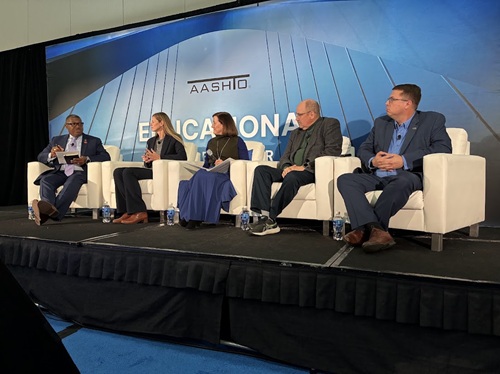
At the American Association of State Highway and Transportation Officials 2026 Annual Meeting in Louisville, KY, a knowledge session examined how state departments of transportation are dealing with changes fostered by the growing use of automated vehicles or AVs and artificial intelligence or AI within the transportation sector.
[Above photo by AASHTO]
Suzanne Murtha, global lead-connected and automated technology for infrastructure consulting firm AECOM – the session’s presenter – moderated a panel discussion that featured Lisa Wilson, deputy director of engineering and operations for the Utah Department of Transportation; Vidhu Shekar, chief data and artificial intelligence officer for the California Department of Transportation, known as Caltrans; Darran Anderson, senior director of strategy and innovation for the Texas Department of Transportation; Kimberly Zimmer, division administrator-transportation systems management and operations for the Michigan Department of Transportation; and Alan Davis, director of operations and permits for the Georgia Department of Transportation.

For starters, Michigan DOT’s Zimmer said state DOTs cannot work in the AV and AI space alone – it requires building a broad swath of partnerships across academia and the private sector.
“We have a lot of partnerships with our automotive manufacturers and OEMs [original equipment manufacturers]. We also have a lot of partnerships with our universities – the University of Michigan, Michigan Tech, and Michigan State – where we’re piloting different types of connected and autonomous vehicles and buses,” she said. “We’re constantly working with M city at the University of Michigan and the American Center for Mobility to test many different [AV] technologies. Right now, in our transit arena, we’re working with Michigan State on deploying full size automated buses on their campus.”
That is only the tip of the iceberg, Zimmer noted, as her agency has “lots of ideas on what we can use AI for,” such as video analytics, traffic congestion, and crash prediction metrics. “We’re trying to use technology to be more proactive,” she explained. “We’re trying to get through the initial framework and determine how we roll this out and use it as a tool to support our operations.”
TxDOT’s Anderson said that Texas has been heavily involved with the testing of automated freight-carrying vehicles and stressed that data flow and AI have become closely aligned with that AV effort.

“We’re working with a task force right now on data integration as we see that [effort] tied into our digital corridors initiatives,” he said. “Yet, at the same time we’re trying to inform the public about that effort, we’re trying to inform the robots. Because it’s one thing to know what you want robots to do; it’s another where we all have agreed upon formats, the means to deliver them, and then understand how each autonomous system actually gets updated.”
Anderson said it then becomes a question of who you’re working with and how they consume and use information.
“It is all about forming a common way of sharing what we know,” he explained. “We’d love to bring in their [data] point clouds and compare those to the [data] point clouds we’re capturing and then maybe we create a shared point cloud environment that enriches our asset management solutions and theirs as well.”
Utah DOT’s Wilson stressed, however, that building such AI connections can significantly boost state DOT capabilities across a variety of areas.
For example, she noted that AI has helped connect Utah DOT’s sole Transportation Management Center or TMC to the state’s entire traffic signal network.
“That is a huge benefit to us when we’re talking about managing our system and operating it most efficiently,” she said. “We don’t always take over our local system signals, but we can we have agreements with them, with a goal to obtain real-time situational awareness so we can react quickly, such as adjusting green signal times to improve [transit] bus on-time arrivals.”
That includes building similar connections across the state’s entire traffic camera network. “We’re having AI connect to our cameras to help us identify crashes more quickly,” Wilson said. “A lot of times, especially in rural areas, we have to wait to hear from [emergency] dispatchers about a crash. But if we have a camera in the area, we can identify it faster. We can identify and remove debris on the roadway faster and remove chances for ‘unexpected congestion.’ That is part of interstate ‘anomaly detection,’ where we know what our everyday ‘normal’ congestion looks like and AI helps us identify and address random issues as well as what we need to fix.”

However, Caltrans’ Shekar noted that this is an example of the high-speed “innovation cycle” for new technologies and systems powered by AI.
“Where initially we were looking at months, if not sometimes years, to think through what our problems were and then getting to the solution, we are now witnessing a development sprint of six weeks – where we went from problem to actually having a solution get deployed in just six weeks,” he said.
And that accelerated development process means the human element in that process must take on greater importance. “We have to go through a process where we analyze the decisions that an AI tool might be making, to make sure that it’s correct, that we agree and that we have confidence in what’s going on,” Shekar noted. “We need to continually be grounded in truthfulness and we must have the human in the loop. You also have the human at the end making the final decision because, ultimately, we’re responsible for whatever decision gets made, whether it’s by AI or not. It’s our stamp, it’s our operations. And so it’s our liability.”
Georgia DOT’s Davis echoed Shekar’s perspective. “Humans make the decision – that is foundational,” he stressed. Still, the speed of development will pose new questions for state DOTs to address in both the AV and AI space going forward.
“The emerging conversation we’re having with the private sector on AV and AI issues is, when we get to novel ideas and concepts, how do we engage with them? Because we’re talking about engaging with software systems that will change from week to week,” Davis said. “That is the next step we have to figure out.”
 Nation
State DOTs Detail Speed Management Strategies for Safety
November 20, 2026 Nation
