


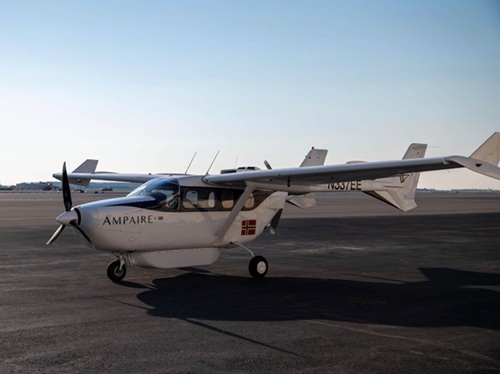
The Utah Department of Transportation recently launched its uFLY initiative by helping sponsor the first cross-state demonstration flight of a hybrid-electric aircraft in Utah.
[Above photo by Utah DOT]
Flown by Ampaire, the hybrid-electric aircraft – named EEL – traveled between Salt Lake City International Airport and Cedar City Regional Airport. The agency noted that its uFLY initiative is a public-private partnership led by Utah DOT that brings together five western states, industry leaders, and research institutions to safely accelerate the integration of advanced air mobility technologies into the National Airspace System or NAS.
By leveraging the West’s diverse geography – from mountain airports to rural communities and desert environments – the program aims to test and evaluate emerging aviation technologies in real-world conditions, the agency said; evaluating how advanced air mobility can improve connections between urban and rural Utah, expand transportation options, and support economic opportunity across the state.
This flight “marks the start of an important effort to test advanced aircraft in real-world conditions,” noted Matt Maass, Utah DOT’s aeronautic director, in a statement.
“Each demonstration helps us better understand how these technologies can safely connect communities and demonstrates why Utah is leading the way in advanced air mobility,” he said.
In March, the Federal Aviation Administration selected Utah DOT to lead one of eight partnerships nationwide for the Electric Vertical Takeoff and Landing or eVTOL Integration Pilot Program, a three-year initiative designed to help safely integrate advanced aircraft into the NAS.

Utah DOT noted that Ampaire’s hybrid-electric aircraft propulsion system combines electric and conventional power; reducing fuel consumption and emissions while maintaining the range, reliability, and operational flexibility needed for regional aviation.
The company’s aircraft have flown more than 35,000 miles, demonstrating the maturity of hybrid-electric technology for today’s aviation network, the agency said.
Ampaire noted that its aircraft use battery technology developed by Utah-based EP Systems, which allows the aircraft to use less fuel while maintaining the range needed for regional flights.
Other states are also expanding their research in eVTOL and similar Advanced Air Mobility or AAM capabilities.
For example, Governor Ron DeSantis (R) recently noted that SunTrax – a 775-acre research and development campus located along the I-4 highway corridor in Polk County, Florida – has expanded its work portfolio to include the testing of AAM technologies alongside connected and autonomous vehicles or CAVs.
“By the end of this year, Florida will be actively testing eVTOL aircraft,” the governor noted in a statement, adding that the Florida Department of Transportation is also partnering with Embry-Riddle University and Polk State University through SunTrax to help Florida students prepare for new career opportunities provided by next generation transportation systems.
“Florida has the innovation-friendly policies, the universities and research institutions, the infrastructure and forthcoming infrastructure investments, and the talent needed to become the premier location for emerging transportation technology,” he said.
 States
Larry Flynn Named as Director for Montana DOT
October 2, 2026 States
