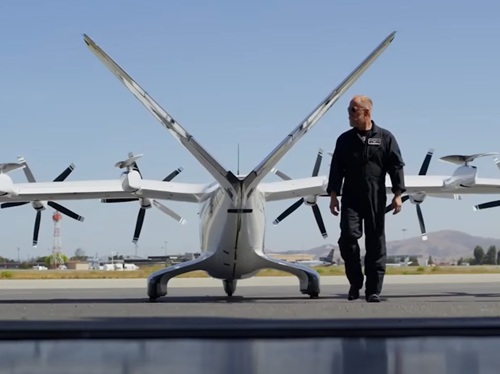
The Federal Aviation Administration recently noted that, in early July, BETA Technologies and United Therapeutics Corporation – in partnership with the Pennsylvania Department of Transportation – flight-tested organ medical-transport capabilities from Virginia to Maryland using Electric Vertical Takeoff and Landing or eVTOL aircraft.
[Above photo by FAA]
The FAA said that flight represents a “milestone” in the FAA’s work to safely launch Advanced Air Mobility aircraft into America’s skies under its eVTOL Integration Pilot Program or eIPP.
BETA’s ALIA electric aircraft flew from Virginia Tech Montgomery Executive Airport to Charlottesville Albemarle Airport carrying an animal organ in a containment system – a medical cooler used to keep donor organs alive and healthy during transport.
Once at Charlotteville, the containment system transferred to another ALIA that then flew to Frederick Municipal Airport in Maryland and finally to Martin State Airport in Baltimore.
Meanwhile, the Pennsylvania Department of Transportation and other eIPP participants are planning additional test flights throughout the rest of 2026, FAA pointed out.
“The eIPP gives us a real-world environment to safely test and integrate the next generation of aircraft into our airspace system,” said Bryan Bedford, FAA administrator, in a statement.
“From urban and rural transportation to lifesaving medical and search-and-rescue missions, these aircraft have virtually unlimited potential and we’re grateful for the partnerships that are helping turn that potential into reality,” he noted.
The eIPP is a “first-of-its-kind program” originally outlined in President Trump’s Unleashing Drone Dominance Executive Order issued in June 2025, FAA noted – a program that creates one of the largest real-world testing environments for next-generation aircraft.
In March 2026, the U.S. Department of Transportation announced it selected eight projects across 26 states – many headed by state departments of transportation – to join the eIPP; projects led by aircraft manufacturers, aircraft operators, and state agencies to test a range of operational concepts including urban air taxi services, emergency medical response operations, and cargo logistics.
The FAA said it will use the findings from these test flights to better understand operational constraints, validate concepts, refine procedures, and inform future policy, training, and integration.
 Nation