


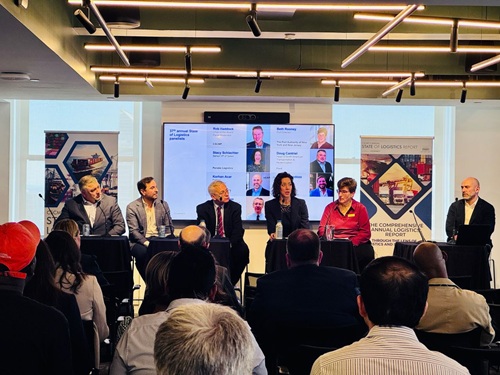
A broad array of ongoing challenges are reshaping the supply chains that serve the United States, according to the annual “State of Logistics Report” produced by global consulting firm Kearney and presented by Penske Logistics, especially energy price volatility; persistent inflation and rising public debt; and geoeconomic “realignment” of global trade flows.
[Above photo by Penske Logistics]
“This year’s report arrives at a moment when the forces reshaping global supply chains are no longer temporary disruptions, but enduring features of the operating environment,” noted Korhan Acar, a partner at Kearney and lead author of the report, in a statement.
“Rising costs driven by energy volatility, inflation, and geopolitical instability are placing pressure on margins and forcing leaders to rethink traditional operating models,” Acar said. “At the same time, we’ve reached a genuine turning point in the autonomous era. AI [artificial intelligence], robotics, and autonomous trucking are moving rapidly from pilot [testing] to scaled deployment. Against this backdrop, profitable growth has become the defining priority. The companies that will lead are those combining resilience, intelligent logistics, and disciplined execution to protect margins and outperform in an increasingly volatile world.”
[Editor’s note: To combat some of those challenges, the U.S. Department of Transportation recently launched the “American Supply Chain Sovereignty Initiative” – an effort to create a high-visibility dashboard connecting major hubs such as the Port of Los Angeles directly to ocean carriers, trucking companies, railroads, and retailers like Walmart.]
“The supply chain of right now is incredibly complex and requires a series of constant adjustments,” added Mark Baxa, president and CEO of the Council of Supply Chain Management Professionals.
“This year’s State of Logistics Report … paints an accurate picture of the myriad dynamics of managing a logistics network constructed to navigate the current business and geopolitical landscape,” he said. “Last year’s supply chain looks different than today’s supply chain. I surmise that next year’s logistics network will be hardly recognizable.”
Notable facts from this year’s report include:
- U.S. business logistics costs came in at $2.4 trillion, amounting to 7.8 percent of the national Gross Domestic Product or GDP. In 2025, those numbers were $2.6 trillion and 8.7 percent of GDP, respectively.
- There are five structural forces that define the macro environment and show no signs of resolution: Asymmetrical global growth; tightening financial conditions due to persistent inflation and rising public debt; accelerating trade flow and geoeconomic realignment; labor market and productivity constraints; and energy price volatility.
- AI has made the crossover from a technology to try to one that delivers measurable commercial returns in specific, well-defined applications. According to the report’s analysis, AI use in the supply chain crafts value via four capabilities: Interpreting, predicting, recommending, and executing. Yet adoption of AI remains uneven by shippers and logistics providers across the supply chain, the report found, with a large gap between companies that have placed AI into core workflows versus those still restricted to isolated point solutions, with many having none at all.
- Companies are responding to labor constraints with accelerated use of automation and digital investments in AI.
- Strategic implications for global and domestic supply chains from those trends include: The need to design supply chains for resilience, not just efficiency; prioritizing asset productivity over footprint expansion; intelligence, and the competitive capabilities that accompany end-to-end visibility; accelerating digital and automation return on investment; and reassessing capital structure and investment pacing.
Meanwhile, state departments of transportation are taking steps to improve the transportation networks used by logistics providers and freight haulers across the country.
For example, the Missouri Highways and Transportation Commission recently approved the 2026 Long-Range Transportation Plan or LRTP developed by the Missouri Department of Transportation; a plan that serves as a guide for the development of the state’s transportation system through 2050.
The agency noted it updated its new LRTP alongside its State Freight and Rail Plan or SFRP, which itself was updated in 2022. MoDOT said the SFRP serves as a comprehensive assessment of Missouri’s freight and passenger rail systems and determines short-term and long-term goals for improving the state’s freight and rail infrastructure. Updating both plans simultaneously ensures a coordinated and well-informed development process, allowing a full view of the transportation system, the agency added.
Meanwhile, the Colorado Department of Transportation formally approved a comprehensive 10-year plan for over 250 projects statewide.
That happened as the Massachusetts Department of Transportation just opened the public comment period for its proposed $20.5 billion fiscal year 2027-2031 Capital Investment Plan; a five-year transportation investment strategy that will guide billions of dollars in infrastructure improvements statewide.
And the Hawaii Department of Transportation is seeking public comment on a draft of its Statewide Long-Range Land Transportation Plan – also known as the Statewide Federal-Aid Highways Transportation Plan – as well as a draft of its Regional Long-Range Land Transportation Plans for the islands of Kauai, Hawaii, Molokai, and Lānai.
 Top Stories
AASHTO Comments on 'Corridors of Commerce’ Program
September 18, 2026 Top Stories
