


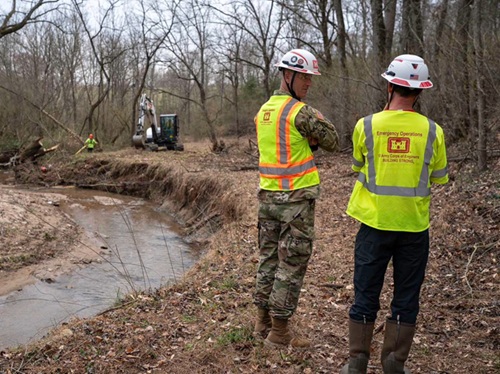
The American Association of State Highway and Transportation Officials recently commented on a U.S. Army Corps of Engineers (USACE) effort to increase the efficiency of the nationwide permit program or NWP.
[Above photo by USACE]
In a May 15 comment letter, AASHTO said the NWP “has important implications for transportation project delivery,” particularly in terms of regulatory predictability, environmental compliance, project budgets, and schedules.
In particular, the organization said state departments of transportation rely on NWPs to authorize routine activities with minimal environmental effects while maintaining predictable budgets and schedules for their projects.
Thus, changing that increase discretionary review or authority, adding new decisions and touch points, or expanding documentation requirements would undermine this purpose and create uncertainty for applicants and permit staff alike, the group said.
“As frequent applicants under the NWP, state DOTs rely on clear national standards, consistent regional implementation, and timely review of preconstruction notifications (PCNs) where required,” AASHTO noted in its letter.
“AASHTO recommends that when evaluating potential changes, the USACE consider whether the proposed changes preserve the distinction between nationwide and individual permits,” the group stressed. “Maintaining a clear, efficient pathway for activities with minimal environmental impacts supports both environmental protection and national transportation priorities.”
Additionally, due to the expanding scope and complexity of regional general conditions and special regional conditions, AASHTO said state DOTs are concerned that the NWP “is losing national effectiveness” for authorizing routine activities. That is because “nationwide consistency remains essential” for the effective use of NWPs, particularly for interstate transportation projects.
“While regional conditions appropriately address unique resource concerns, layered regional conditions complicate compliance and undermine the nationwide applicability of permits,” AASHTO said.
Finally, the expansion or inconsistent application of PCN requirements, thresholds, or triggers significantly increase administrative burden without a corresponding environmental benefit – placing additional strain on USACE district resources that can create extended review periods.
“With each reissuance [of NWP rules], regional conditions have become more extensive, often undermining the intended streamlining benefits of the NWPs,” AASHTO said. “In some cases, added regional requirements negate efficiencies by triggering PCNs, individual water quality certifications, and mitigation obligations for activities that would only require limited scrutiny.”
 Top Stories
FRA Issues $2.3B in CRISI Grants to 105 Rail Projects
October 23, 2026 Top Stories
