


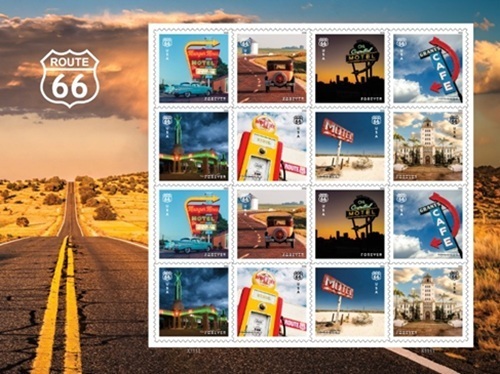
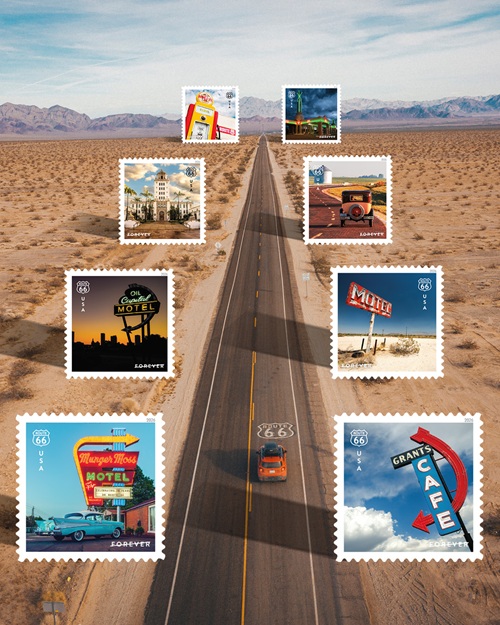
The U.S. Postal Service recently issued a set of eight stamps honoring the centennial of Route 66, with each stamp showing a site from the states which the roadway runs through – with those stamps based on photos taken by David Schwartz.
[Above image by the USPS]
Jeff Adams, USPS vice president of corporate communications, said these stamps honor the 100th anniversary of the Route 66, which originally stretched about 2,400 miles from Chicago to Los Angeles.
“The Postal Service and Route 66 both played historical roles in our nation’s expansion, as conduits for goods and communication — moving hundreds of thousands of letters and packages for Americans as they journeyed westward,” he said in a statement. “These stamps feature many sights that travelers or transport drivers would have seen in the ‘Mother Road’s’ heyday; sights that have become popular stops for tourists today.”
When the route was first mapped, it stitched together a patchwork of existing, mostly unpaved roads to form a continuous 2,448-mile highway passing through eight states: Illinois, Missouri, Kansas, Oklahoma, Texas, New Mexico, Arizona and California. Its eastern terminus was at the intersection of Michigan Avenue and Jackson Boulevard in Chicago, and the western terminus was at Broadway and Seventh Street in Los Angeles. Rather than follow a linear course, Route 66 meandered across the country, connecting small rural communities that might otherwise have been bypassed. The Chicago-to-Los Angeles route was designated Route 66 on November 11, 1926.
“The Route 66 stamp issuance represents an open invitation to come experience Route 66 for yourself along with the many historic and iconic landmarks you’ll see along the way,” added Rod Reid, chairman of the United States Route 66 Centennial Commission.
Route 66 was a lifeline for people seeking better opportunities during the Great Depression in the 1930s and earned the nickname “The Main Street of America.” The highway also transformed the U.S. trucking industry by offering an alternative to rail shipping, and during World War II, it carried job seekers westward to defense plants as military bases were established along the route.
[Editor’s note: In its previous incarnation as “AASHO,” the American Association of State Highway and Transportation Officials formally approved Route 66 in November 1926 for the newly designated U.S. Numbered Highway System. Route 66 was also a comparatively late entry, albeit one that ultimately played a pivotal role in making the numbered highway system a reality, AASHTO noted.]
After the war, Route 66 became a symbol of postwar optimism — an image of the freedom of the open road and the adventure of the West. With newfound prosperity and a car in the driveway, families explored the country and often relocated in the West, especially soldiers who had trained there during the war. The soundtrack of this “golden age” was Bobby Troup’s hit song “(Get Your Kicks on) Route 66,” recorded by Nat King Cole in 1946.
Over time, Route 66 was gradually replaced by I-55, 44, 40, 15 and 10, which parallelled or were built over much of the original route – roadways constructed by the Federal-Aid Highway Act of 1956, signed into law by President Dwight Eisenhower. By 1984, the last section of Route 66 was bypassed, and the road was officially decommissioned in 1985.
 Nation
Air Taxi Demonstration Conducted at Texas Airport
September 18, 2026 Nation
