


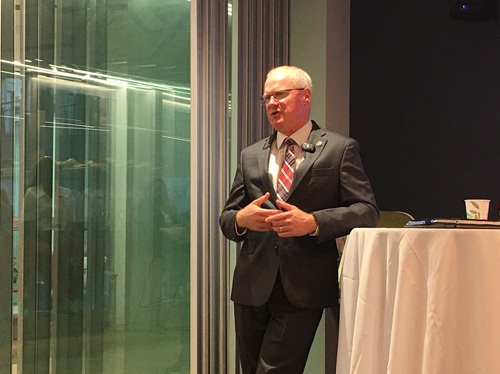
Russell McMurry (above), commissioner of the Georgia Department of Transportation and 2025-2026 president of the American Association of State Highway and Transportation Officials, recently discussed several key trends affecting the state department of transportation community during a visit to the organization’s office in Washington, D.C., on April 28.
[Above photo by AASHTO]
In addition to serving as a featured speaker at the four-day AASHTO Executive Institute for state DOT executives, McMurry discussed a wide range of topics in his talk with AASHTO staff – from how the different jobs he’s held during his 35-year career at Georgia DOT influenced his perspective on the transportation sector to the importance of getting federal surface transportation funding reauthorized.
[Editor’s note: McMurry also addressed similar themes in a recent episode of ‘The Stream by AASHTO’ podcast and in his presidential emphasis video below.]
“Without reauthorization [of federal surface transportation funding], it’s hard for state DOTs to plan and execute our mission. That’s what it so important,” he stressed. “However, we can have reauthorization in place; we can have the money for projects. But unless we’re getting those projects done and getting those programs delivered, what’s the point?”
That’s why he believes deploying new technologies will be critical to improving the process for getting transportation projects completed, McMurry emphasized. “Look, my dishwasher connects to Wi-Fi. So can we not use technology to help move projects more efficiently?”
He did stress that a lot of details need to be aligned first for technology to help achieve project delivery improvements. “Data standards and things that have to be worked out; they become very important,” McMurry noted.
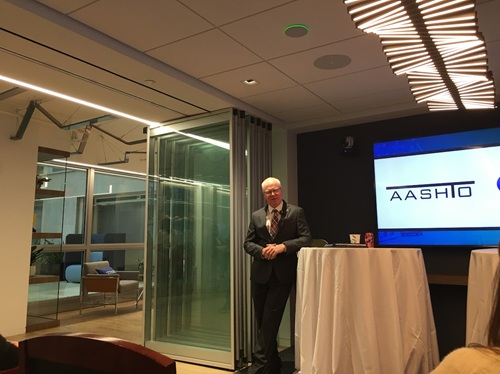
He also feels that there has to be a workforce in place to support such efforts and McMurry feels that state DOT employees are ready for the challenge.
“There’s not any better [group] of state agency employees than state DOT employees,” he stressed. “I’ve never seen more committed and dedicated people, especially in the worst of times when bad things happen. You know, hurricanes, snowstorms, ice storms, and tornadoes. It’s amazing to see how state DOTs respond. I have a huge appreciation of the work that they do.”
Keeping that caliber of employee at a state DOT, however, is becoming more challenging and McMurry thinks state DOTs need to shift their strategies to a degree to keep their ranks filled.
“One of the reasons I stayed at Georgia DOT is that they invested in me with learning opportunities and you are engaged in fulfilling work,” he said. “If we’re investing in people – and they feel like you’re investing in them – hopefully, they stay with you longer.”
McMurry did emphasize that the expected employment “lifecycle” for state DOT workers is changing, regardless of such job training investments, so state DOTs need to adapt accordingly.
“I don’t have any expectation that somebody’s going to be here 35 years anymore,” he said. “I say, now, let’s think about a pretty solid career being five years and a long one as 10 years. How do we change what we’re doing, to try to satisfy that? That’s why I joke around that, you know, we should be the ‘Georgia Department of Transportation and Education.’ That’s what I’m telling our administration and HR [human resource] folks. We’ve just got to continue to double down in training and learning opportunities.”
 Top Stories
AASHTO Comments on 'Corridors of Commerce’ Program
September 18, 2026 Top Stories
