The American Association of State Highway and Transportation Officials recently provided input to the Federal Motor Carrier Safety Administration regarding the agency’s notice of proposed rulemaking or NPRM to add a railroad crossing exemption for commercial motor vehicles or CMVs in specific situations.
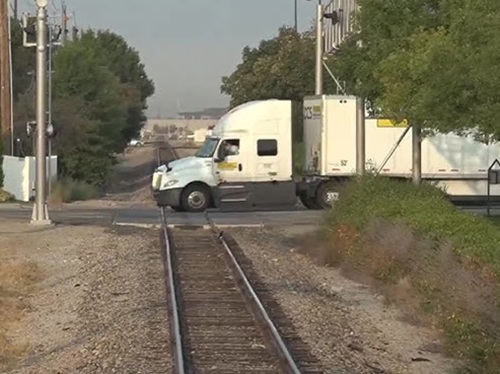
[Above photo by Operation Lifesaver]
That exception would allow certain CMVs to travel through a highway-rail grade crossing without stopping if the crossing is equipped with an active warning system, such as lights and gates, and the crossing warning system is not activated.
“AASHTO noted that the proposed rule change would be added to an existing list of exemptions concerning when it is not mandatory for these CMVs to stop at a grade crossing,” the organization said in a comment letter to FMCSA. “Subject matter experts within the state department of transportation [community] reviewed the proposed rule and considered it in the context of existing AASHTO policy priorities.”
That said, AASHTO stressed that its state DOT members had “significant concerns” with statements in the NPRM indicating that FMCSA did not possess data on the number of stops that the proposed rule would eliminate because it cannot be estimated, as well as the assertion that there is no data on grade crossing encounters for the kinds of vehicles contemplated in the NPRM.
“AASHTO also noted that the NPRM states that cost estimates on savings that could result from this rulemaking cannot be developed because FMCSA asserts that there is no data on the number of grade crossing encounters for CMVs and passenger buses carrying hazardous materials,” the group noted.
“Our members continue to have concerns about the quality and amount of data available,” AASHTO added. “[We] continue to urge FMCSA to work with state DOTs, relevant federal agencies – such as the Federal Highway Administration, Federal Railroad Administration, and Bureau of Transportation Statistics – and industry partners to obtain additional credible data and more detailed information on the potential impact of this proposed rule.”