


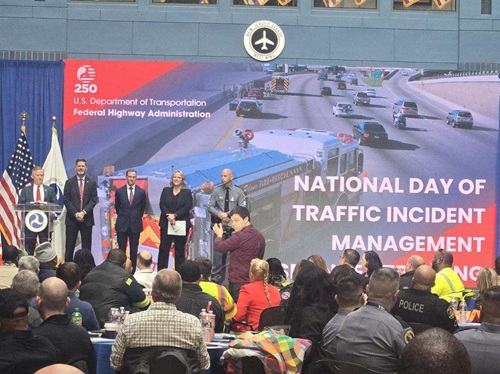
On April 9, the U.S. Department of Transportation held its first-ever National Traffic Incident Management Responder Training Day at its headquarters in Washington, D.C. – hosting more than 100 law enforcement officers, first responders, and state and local transportation officials to learn proven practices that support the rapid and safe clearance of roadway incidents.
[Above photo by USDOT]
Traffic Incident Management or TIM is a standardized set of best practices for first responders to utilize as they detect, respond to, and clear crashes and other traffic incidents. USDOT said effective implementation of TIM practices can reduce congestion, limit secondary crashes, and improve safety for motorists, crash victims, and responders working in high-risk roadway environments.
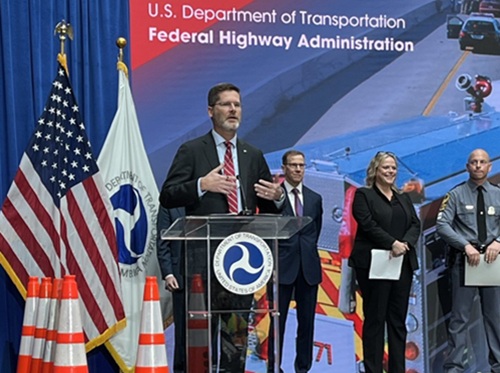
The national TIM training program – led by the Federal Highway Administration – teaches police, firefighters, highway workers, paramedics, and towing personnel best practices for safe, coordinated crash response, quick scene clearance, improved communication, and prevention of secondary crashes.
The agency said such training is offered at no cost and participants can choose from several delivery options: an in-person four-hour course, an online multi-module version, or an interactive instructor-led virtual session. FHWA noted that more than 869,000 responders have been trained with TIM training to date.
Concurrently, many state departments of transportation hosted their own TIM training sessions in support of the national efforts.
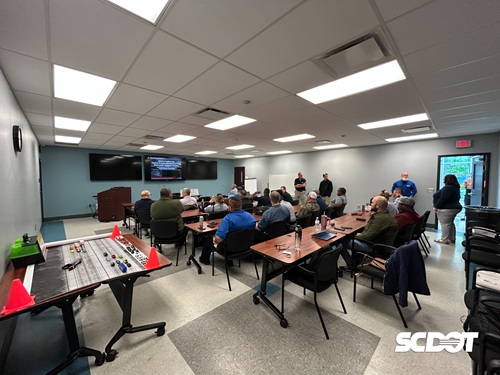
The South Carolina Department of Transportation hosted a TIM training event in the Midlands region of the state to bring together first responders and transportation professionals – including law enforcement, fire and rescue, emergency medical services, towing and recovery, and transportation personnel. Participants engaged in collaborative hands-on instruction designed to improve coordination at incident scenes and enhance safety for both responders and the traveling public, the agency said.
“Traffic incident management is critical to keeping both our responders and motorists safe,” said Kell Robinson, TIM program manager for SCDOT, in a statement. “[This] training highlights the importance of strong partnerships and coordinated response efforts that help save lives, reduce congestion, and clear incidents more efficiently.”

Meanwhile, the Nebraska Department of Transportation hosted a TIM Responder Training Course at the Nebraska State Patrol headquarters in Lincoln, NE. That event supports a national goal, established in 2015, to train one million first responders in TIM practices, Nebraska DOT noted.
As part of this nationwide initiative, the agency noted it has set a goal of training 1,000 responders each year, helping improve on-scene coordination and enhance safety for both responders and the traveling public.
In 2025, Nebraska DOT held 52 statewide TIM training sessions, with 952 responders completing those courses. So far in 2026, the agency said it has trained 509 first responders across 24 TIM training sessions.
“Traffic Incident Management training is a critical part of keeping Nebraska’s roadways safe,” emphasized Vicki Kramer, director of the Nebraska DOT, in a statement.
“When we looked at TIM, we saw an opportunity to build an organized, consistent emergency response system along I-80 – from Ogallala to Omaha,” she added. “We’ve now deployed these proven, consistent trainings and techniques along the entire Interstate corridor, and the results we’ve seen have encouraged us to start expanding to rural areas as well.”
 Nation
AASHTO Offers FHWA Performance Management Insights
October 23, 2026 Nation
