


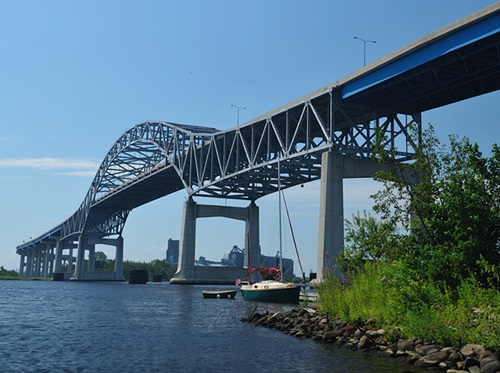
Key bridge projects in several parts of the country recently achieved key funding and design milestones.
[Above photo by MnDOT]
For example, Minnesota recently secured more than $1 billion in federal investments to replace the John A. Blatnik Bridge between Duluth, MN, and Superior, WI – clearing the way for the largest public works project in that state’s history.
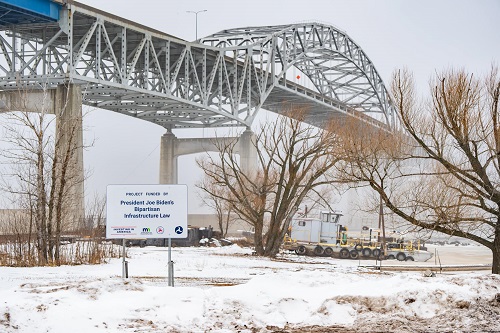
The Blatnik Bridge – which originally opened in 1961 and is nearing the end of its service life – is jointly owned and managed by the Minnesota Department of Transportation and Wisconsin Department of Transportation, carries I-535 over St. Louis Bay, and handles approximately 33,000 vehicles daily. It is also a critical freight corridor, supporting more than $3.7 billion in goods movement annually between the Twin Ports.
The replacement of the Blatnik Bridge is estimated to cost $1.8 billion, with Minnesota and Wisconsin each committing $400 million in state funding to the construction of a new structure and MnDOT tagged to lead the project. The project received a more than $1 billion federal grant in January 2024 after passage of the Infrastructure Investment and Jobs Act, which the U.S. Department of Transportation finalized this week. Preliminary construction is expected to begin in late 2026.
“Replacing the Blatnik Bridge will improve safety, strengthen our economy, and support thousands of good-paying jobs,” noted Governor Tim Walz (D) in a statement. “Minnesota is ready to break ground and get this project started.”
“The Blatnik Bridge project is the top priority project for MnDOT and securing this grant means the project can continue without delay,” said Nancy Daubenberger, MnDOT commissioner. “This project is happening because of a strong partnership between Minnesota, Wisconsin, local, tribal, and federal officials, our industry partners and our building trades. We look forward to continuing to work with our partners as we get closer to breaking ground and replacing this bridge.”

Meanwhile, the Ohio Department of Transportation and the Kentucky Transportation Cabinet recently announced that the Ohio Controlling Board has approved finalized plans for the Brent Spence Bridge Corridor project – with construction on the project’s companion bridge expected to begin this spring.
The start of major construction will represent a major milestone in the overall project to transform I-71/I-75 in Kentucky and I-75 in Ohio, addressing one of the most severe traffic bottlenecks in the country while connecting communities on both sides of the corridor and the Ohio River.
“This project has been discussed for decades, and we are now at the point where plans are becoming reality,” noted Pamela Boratyn, Ohio DOT’s director, in a statement. “This project will make travel safer, strengthen the economy, and build a transportation system that reflects the importance of this region to Ohio, Kentucky, and the nation.”
“We are delivering on a promise to families, businesses and freight carriers who rely on this corridor every day and have been awaiting a better, safer commute,” added Jim Gray, KYTC’s secretary. “This is a historic year for the entire Northern Kentucky and southwest Ohio region, and we are excited for all the good work our teams have been doing behind the scenes to lead to visible action aimed at improving the lives of the communities we serve.”
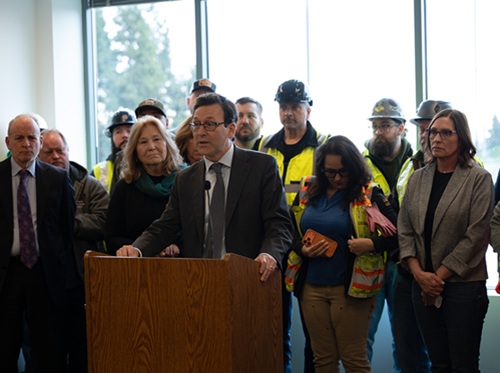
Finally, the governors of Oregon and Washington State recently recommitted their respective administrations to replace the 109-year-old Interstate Bridge, which represents a critical connection between the two states over the Columbia River.
“While costs have increased due to a variety of factors, the need to replace this outdated bridge has not changed — and delaying action only increases risk and expense,” they noted in a joint statement. “With the exciting news of the Coast Guard’s recent approval of a fixed-span bridge, we have the momentum to move forward and begin construction on the first, core set of projects that will allow us to deliver a safer, more earthquake-ready bridge, connect the bridge to Interstate 5, and extend light rail service to Vancouver.”
Both governors said the bridge’s “core set of projects” is substantially funded and final federal approval is expected shortly.
 Top Stories
Western State DOT Projects Win Regional Awards
July 24, 2026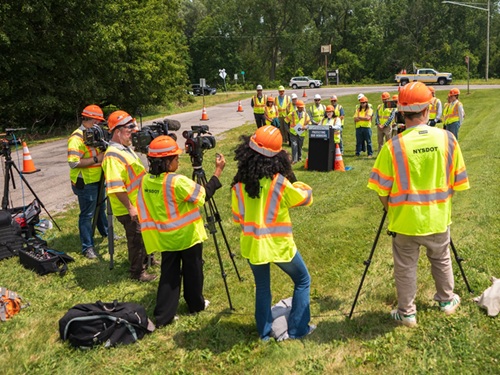 Top Stories
