



The American Association of State Highway and Transportation Officials recently hosted a knowledge session that examined a number of truck parking issues at its 2026 Washington Briefing in Washington, D.C.; and how state departments of transportation are collaborating with the private sector to solve them.
[Above photo by AASHTO]
John Hartland, director of North American surface transportation for Amazon – the session’s presenter – moderated a panel discussion that included Mike Carroll, secretary of the Pennsylvania Department of Transportation; Erica Hawkins, assistant director, business and human resources, for the Ohio Department of Transportation; Ray Moravec, deputy chief engineer for the Maryland Department of Transportation; and Darius Pakbaz, director of the Division of Transportation Development within the Colorado Department of Transportation.
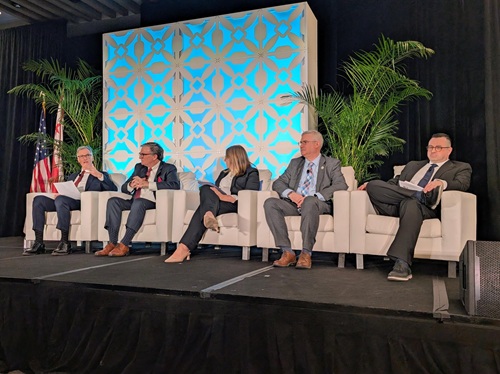
“We have a growing number of trucks on the road, fueled in part by a huge explosion of warehousing across the states,” noted PennDOT’s Carroll. “That is creating tremendous challenges for truck drivers to find parking, both across the nation and in Pennsylvania. Trucks are parking on [on/off] ramps, on highway shoulders; it is unsafe for them and for the public.”
As a result, he said Pennsylvania is working to find quick ways to make safer parking options available to truck drivers, as part of a commitment to add at least 1,200 truck parking spaces by the end of 2026.
Ohio DOT’s Hawkins noted that, in 2024, Governor Mike DeWine (R) directed her agency to address the lack of truck parking statewide and to begin building additional truck parking sites as soon as possible. Following an extensive review of its property, Ohio DOT announced plans in 2025 to add at least 1,400 new truck parking spaces at 33 sites statewide.
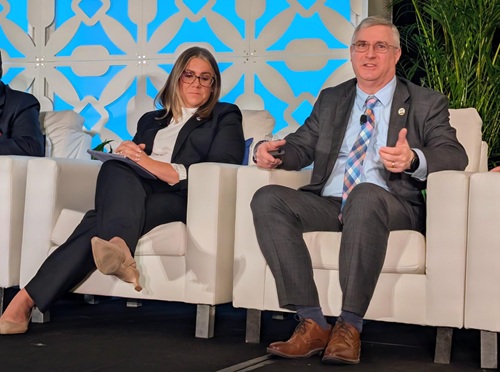
“We are also looking at all of our underutilized inventories – by location, size, and environmental concerns,” she said. “That allowed us to quickly start work on 33 new sites for truck parking. “Obviously much more is needed, which is why our state’s plan aims for more than 1,400 new spaces in total.”
Maryland DOT’s Moravec said his state’s freight plan includes an initiative to build a travel reliability index to keep freight moving while minimizing parking issues based on a freight distribution network.
“We are also taking a strategic look at our overall ‘park and ride’ commuter plan so it includes truck parking needs,” he said. “We are also identifying areas of overparking, shoulder/ramp parking, and how we can address emergency parking needs such as with snowstorms. That also includes providing real-time communication of parking information to truck drivers.”
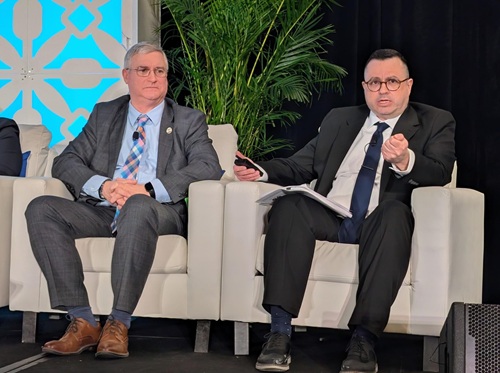
Moravec added that the impact the Francis Scott Key Bridge collapse in March 2024 on the state’s freight patterns cannot be understated. “That bridge provided key access [for trucks] to the port of Baltimore,” he said. “We are now really constrained – and that includes hazmat [hazardous material] hauling, as they cannot use tunnels. The bridge collapse changed our state’s whole dynamic of freight traffic.”
Colorado DOT’s Pakbaz said working with local governments is a critical part of addressing statewide truck parking issues as well. “The challenge is to build truck parking where needed most, but land planning and zoning authority begins at the local level; and state DOTs do not have land use or zoning authority,” he explained. “We cannot solve this problem on our own, which is why partnerships with local governments and private entities are so important.”
As an example of such successful joint projects, he pointed to a venture completed nearly four years ago with the Town of Bennett – located just outside of Denver – to help a local Love’s Travel Stop location add 114 truck parking spaces. “The Colorado DOT improved an overpass to handle increased truck volume coming off the highway, while the town made intersection improvements,” Pakbaz said. “Working together helped turn Love’s plan for additional truck parking spaces into reality.”
 Top Stories
FRA Issues $2.3B in CRISI Grants to 105 Rail Projects
October 23, 2026 Top Stories
