


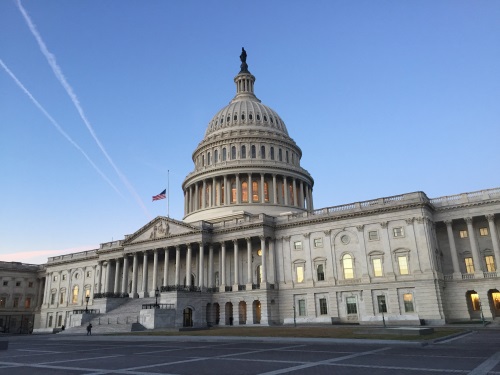
Two members of the House of Representatives – Rep. Kristen McDonald Rivet (D-MI) and Rep. Rob Bresnahan (R-PA) – recently introduced the Bridges and Safety Infrastructure for Community Success or “BASICS” Act, which seeks to fundamentally rebalance the Federal-aid Highway Program away from states toward more localized control.
[Above photo by AASHTO]
According to analysis by the American Association of State Highway and Transportation Officials, that bill would create a significant shift in the disbursement of Highway Trust Fund dollars, from the current 85 percent state-15 percent local split to a 75 percent state-25 percent local split.
AASHTO’s analysis indicates that the practical effect of this legislation would be to fragment program delivery, slow obligation rates, and weaken the statewide systems that carry about 70 and 90 percent of nationwide roadway and bridge traffic, respectively.
The BASICS Act – which represents the surface transportation reauthorization proposal from the Local Officials for Transportation or LOT coalition that includes cities, counties, Metropolitan Planning Organizations (MPOs), Regional Planning Organizations (RPOs), and regional councils – would expand the share of locally-controlled suballocation dollars from a range of formula programs by reducing the amount of flexible formula funding that states are able to use on projects in any area of their state.
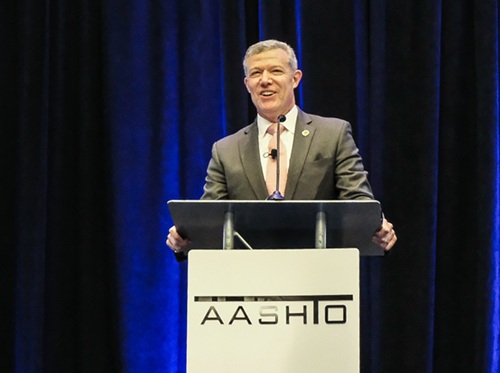
“Local governments are indispensable partners in delivering safe, efficient, multimodal transportation systems to communities across the country. That’s why states have provided more than $24 billion annually in more flexible state funding for local projects on top of the $9.4 billion of federal formula funds currently controlled by localities,” noted Jim Tymon, AASHTO executive director.
“However, reducing the amount of the federal share disbursed to state DOTs will have dire consequences for state DOT budgets, which hold responsibility for roadways carrying over 70 percent of the nation’s vehicle miles traveled and nearly 90 percent of the country’s bridge traffic,” he stressed. “We can all agree that more investment is needed to support our nation’s transportation infrastructure. But slicing the federal funding pie differently won’t achieve anyone’s goal of delivering projects faster, compared to the current balance of federal and state funds that enable coordinated and timely multimodal investments in safety and mobility projects both locally and nationwide.”
The legislation also aims to continue the Bridge Formula Program established by the Infrastructure Investment and Jobs Act or IIJA and supported by the general fund by creating a new federal “Strengthening Bridges” formula program through the Highway Trust Fund. That new program would provide roughly $5.5 billion per year for fiscal years 2027 through 2031, with apportionment based on each state’s share of the estimated cost to rehabilitate or replace bridges in poor condition, using National Bridge Inventory data.
The revamped bridge program would require that 25 percent of those federal bridge funds be obligated across population-based categories (urbanized, small urban, rural), with remaining funds available for statewide use. In metropolitan areas, those bridge projects would have to be included in the MPO Transportation Improvement Program, whereas in non-metropolitan areas, projects must be identified in consultation with regional transportation planning organizations (RTPOs) or local governments. The program would also provide a 100 percent federal share for locally owned off-system bridge projects as well, AASHTO said.
The BASICS Act also seeks to establish a new funding program to support regional transportation planning in both metropolitan and rural areas by increasing MPO funding to 247 percent of current funding and creating a new planning program for rural organizations funded at $150 million per year for FY 2027 through 2031.
Finally, the BASICS Act seeks to make major changes to the Highway Safety Improvement Program (HSIP) – amending it to require that 25 percent of HSIP funds be obligated according to population-based categories for FY 2027–FY 2031.
The bill would also expand the definition of eligible safety projects to include additional infrastructure-related safety activities referenced in other federal statutes, while retaining existing HSIP requirements related to safety performance measures and reporting.
The proposed legislation also seeks to modify the authority to transfer HSIP funds to other program, requiring states – before transferring HSIP funds – to make those funds available through a “competitive process” to local governments and RPOs. It would also require certification by the U.S. Department of Transportation that the competitive process was “open and fair” prior to allowing a funds transfer.
Additional changes proposed by the BASICS Act include increasing MPO and locality control over planning, programming, and fund administration without requiring corresponding project delivery outside of a pilot program and requiring development of new administrative processes related to competitive funding availability, certification, and direct recipient status for MPOs.
 Top Stories
House Passes Senate CR to Extend Federal Gov't Funding
September 3, 2026 Top Stories
