


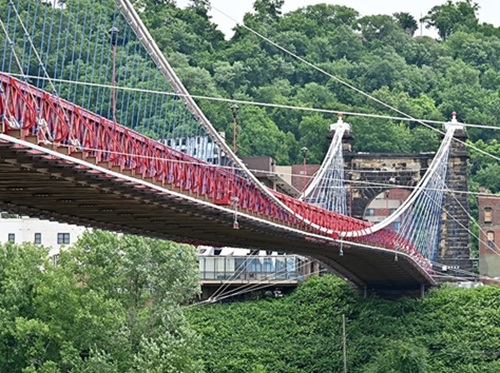
The West Virginia Division of Highways (WVDOH) – part of the West Virginia Department of Transportation – recently met with officials from the city of Wheeling to update them on the future of the Wheeling Suspension Bridge.
[Above photo by WVDOT]
The first bridge in America to span the main body of the Ohio River, the bridge was designed by Charles Ellet Jr., and built by the Wheeling and Belmont Bridge Company. Construction began in 1847, and the bridge opened to traffic in November 1849.
In 2019, WVDOT closed the bridge to vehicular traffic after an overweight tour bus crossed the span in defiance of weight restrictions and permanently damaged the structure.
Now, the WVDOT is undertaking a project to enhance lighting, signing and other features for future pedestrian use of the structure.
“While the Wheeling Suspension bridge may no longer support traffic between downtown and Wheeling Island, [we are] committed to ensuring the bridge continues to be centerpiece of the community,” said Todd Rumbaugh, WVDOT secretary, in a statement.
“My team and I are just the latest in a long line of stewards tor this iconic structure,” he said. “Our goal is to ensure this bridge is around for future generations to enjoy.”
The bridge was listed in the National Register of Historic Places in 1970 and designated a National Historic Landmark in 1975 as a “rare extant example” of an antebellum engineering structure. It remains the oldest major long-span suspension bridge in the world, with a span of more than 1,000 feet, WVDOT noted.
“This bridge was designed and built in the days of horses and buggies,” said Tracy Brown, WVDOH state bridge engineer. “That it has lasted as long as it has is a testament to 19th-century engineering.”
Brown said WVDOH engineers are securing a study to identify measures to preserve the bridge while complying with National Historic Landmark Standards. That study will include a review of options to reduce the weight of the existing bridge deck, design repairs to the original suspension cables, make masonry repairs to the towers, clean the cut stone and replace the timber stiffening trusses.
Once an engineering consultant is under contract, significant coordination will begin with the public, state/federal resource agencies and other interested parties to ensure the project meets both the engineering standards and that the repairs do not affect the historical integrity of the bridge.
 States
Louisiana Celebrates Completion of $30M Bridge Project
February 20, 2026 States
