


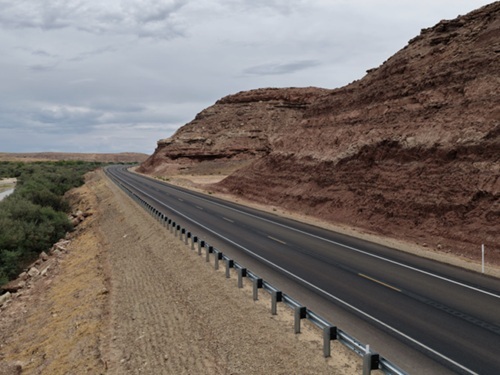
The Utah Department of Transportation recently wrapped up work on a $152 million project along State Route 162 and State Route 262 in San Juan County; an area in southwestern Utah known locally as the “Energy Corridor” that provides the primary state highway access to communities within the Utah portion of the Navajo Nation as well as access to the Bears Ears Visitors Center, the Hovenweep National Monument, and the Four Corners Monument.
[Above photo by Utah DOT]
“In this part of San Juan County, these roads are far more than rural highways,” explained Carlos Braceras, Utah DOT’s commissioner, in a statement. “They are local roads that represent daily commutes and essential connections to the rest of the state. By working with the Navajo Nation and local communities, we’ve made these everyday trips safer, smoother, and more reliable.”

He added that Utah DOT partnered with the Navajo Nation to secure a $48 million Nationally Significant Federal Lands and Tribal Projects grant to help fund the “Energy Corridor” rural highway project.
The agency noted this project improved 53 miles of SR-162 and SR-262 with new pavement, wider shoulders, upgraded drainage, a new roundabout, and a replacement bridge over McElmo Creek.
Crews also installed more than six miles of guardrail, new fencing, over 50 cattle guards and two livestock crossings under SR-162. They also updated signs and lane markings and built a roundabout at the SR-162 and SR-262 intersection in Montezuma Creek.
Utah DOT noted that construction crews also rebuilt more than eight miles of SR-162 between Montezuma Creek and Aneth for this project; shifting the highway away from the river and closer to the mountainside.
Blasting and large rock cuts improved curves and sight distance, while new embankments created wider shoulders and more recovery room along the road, the agency said.
On SR-262, crews reshaped steep roadside slopes and moved earth from higher areas to lower areas to improve shoulders and recovery areas. They also added guardrail in key locations and relocated dozens of utility lines outside the highway right-of-way.
Together, all of those improvements give motorists more room to maneuver, increase visibility, and help reduce conflicts with livestock and roadside hazards.
“With the completion of this project, drivers will see immediate safety improvements,” noted Devin Squire, Utah DOT project manager. “There’s more space, better visibility and more protection from roadside hazards. This corridor looks and feels very different than it did before.”
 States
Nebraska Highlights New State Infrastructure Initiative
September 11, 2026 States
