


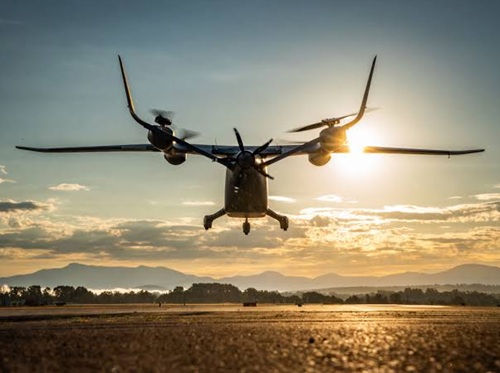
The Utah Department of Transportation recently provided support to two critical Advanced Air Mobility or AAM test efforts: welcoming an autonomous J208 aircraft equipped with “Superpilot” autonomous flight technology as part of the Electric Skies tour – a coast-to-coast journey covering a dozen cities and 5,541 nautical miles – and hosting a demonstration flight of an all-electric ALIA CX300 aircraft.
[Above photo by Utah DOT]
The Utah stopover by the J208 aircraft – an airplane developed and operated by Joby Aviation – was the second-to-last stop on its cross-country journey, highlighting the state’s role as a national leader in the development and deployment of Advanced Air Mobility or AAM technologies.
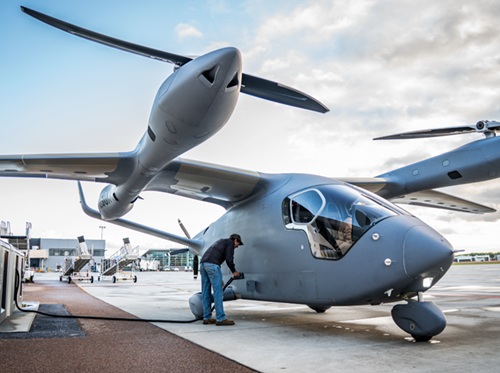
Meanwhile, the ALIA CX300 test flight supported by Utah DOT in partnership with BETA Technologies and 47G is the latest in a series of real-world flight operations conducted through uFLY initiative, the agency’s multi-state initiative designed to safely accelerate the integration of advanced aviation technologies into the state’s airspace.
“Transportation is evolving, and we want Utah to help lead the way,” noted Carlos Braceras, commissioner of the Utah DOT in a statement.
“For decades, we’ve worked to find better, safer ways to move people. Now, we’re exploring how advanced aircraft can become part of that future,” he explained.
“Through uFLY, [we are] testing technology in real-world conditions [to] help us understand how it can safely integrate into the transportation systems Utahns rely on every day,” he said.
“Utah has always been a place where innovation and big ideas can take flight. We are actively building a future transportation system that includes advanced air mobility solutions,” added Matt Maass, Utah DOT’s aeronautics director, in a separate statement.
Maass said that the supervised autonomous J208 flight is more than a demonstration of new aircraft technology; “It is helping to generate important data that will be used to inform safety standards, future infrastructure decisions and operating best practices for AAM deployment across Utah.”
He pointed out that such aircraft would be part of a larger, connected transportation system linking communities to existing infrastructure such as airports, transit networks, and roadways.
With 90 percent of Utahns living within 30 minutes of a regional airport, autonomous aviation is not intended to replace existing transportation systems, but to enhance them – ultimately creating new connections between communities and expanding access to jobs, services, and opportunities, he said.
Concurrently, BETA’s test of its all-electric ALIA CTOL offers a “potential pathway” for introducing electric aviation without requiring an entirely new airport system. The ALIA CTOL has demonstrated a maximum range of 336 nautical miles and BETA is also building an integrated electric aviation ecosystem that includes aircraft, electric motors, batteries and charging technology to enable this industry to scale. Specifically for Utah, BETA already has charging capabilities in place across the state with a high-speed Charge Cube under construction at Salt Lake City International Airport.
“Utah’s aerospace industry has made a serious commitment to developing the technologies that will define the future of transportation,” said Aaron Starks, president and CEO of 47G. “With partners like BETA investing, innovating and putting new capabilities into operation, Utah has an opportunity to complement our existing transportation system in new ways.”
 States
Tim Gatz Stepping Down as Oklahoma DOT Director
October 9, 2026 States
