


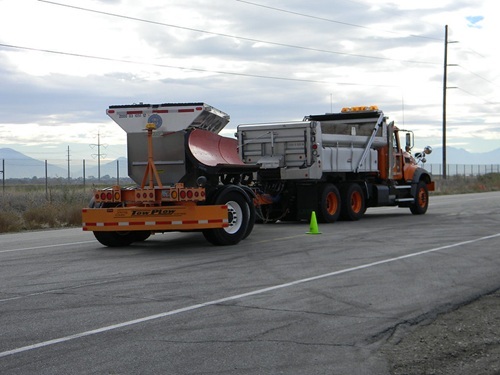
The Utah Department of Transportation is expanding its vehicle-to-everything or V2X smart technology communication network to include more of its snowplow operations – connecting 259 snowplows statewide to nearly 1,275 signalized intersections on essential winter routes.
[Above photo by Utah DOT]
Using V2X technology, snowplows communicate directly with traffic signals and roadside equipment – giving them the “green light” at equipped intersections so they can keep moving uninterrupted along major corridors during snowstorms.
By reducing unnecessary stops, V2X helps crews clear snow more efficiently, reduce traffic congestion, and improve safety during winter storms. When fully deployed, this technology will support snow removal operations serving more than 90 percent of Utah’s population, the agency added.

“In a major storm, every second matters,” said Blaine Leonard, Utah DOT transportation technology engineer, in a statement. “This technology serves as a digital seatbelt, providing Utah drivers an unseen layer of protection while helping plows move through intersections faster so crews can clear roads more quickly.”
[Editor’s note: Leonard noted that the agency has been experimenting with V2X technology since 2015 and has been using it along several snowplow routes in Salt Lake and Utah counties since 2025.]
UDOT maintains more than 16,000 lane miles statewide and deploys hundreds of snowplows during major storms. Strategically expanding this smart technology on highly traveled roads and critical freight routes helps prioritize snow removal where it has the greatest impact, the agency said.
“Getting the green light makes a night-and-day difference,” said Codie Alsop, a Utah DOT snowplow driver. “We spend less time stopped at lights and more time actually clearing snow. During a storm, that matters.”
Across the country, state departments of transportation are tapping into a variety of technologies and chemical formulations to improve their winter operations.
For example, the Kentucky Transportation Cabinet is using a new de-icing agent – an agricultural byproduct containing a small percentage of desugared beet juice – mixed with salt to increase its effectiveness when temperatures drop below 25 degrees; the threshold at which brine is not recommended.
[Editor’s note: The Wisconsin Department of Transportation recently shared results from a recent university-led research project that reinforces the effectiveness of salt brine applications in winter highway maintenance compared to traditional granular salt.]
And to further strengthen statewide preparedness, KYTC installed new Roadway Weather Information System cameras this year to capture roadway images and weather data in real time. The compact, solar-powered devices are installed on existing infrastructure, such as light poles and traffic signals, to help officials monitor pavement conditions and make road-clearing decisions.
Forty-three of 50 cameras have already been installed, with this technology expected to help KYTC crews track storms, assess conditions in hard-to-reach areas, and make data-informed decisions for treatment, maintenance and emergency response.
“From the first flurries to the harshest storms, our team is on high alert to act when and where needed to maintain critical access for Kentuckians,” said Jim Gray, KYTC’s secretary, in a statement. “New cameras and road clearing materials are giving us both real-time visibility and new options to be more equipped than ever before to keep Kentuckians and crews safer.”
Out west, the Idaho Transportation Department installed and tested upgraded lighting packages this winter for its snowplows that feature:
- Two higher-mounted over-cab strobe lights.
- Four larger, sturdier wing lights mounted atop and at the side of the wing blade itself.
- Six total lights at the back of the truck, both strobing and alternating.
- New reflective orange and yellow checkerboard striping at the back of the plow truck.
- A whip-style, green rod light that extends six inches high at the edge of the wing plow.
Ty Winther, ITD’s operations manager, said the “green whip light” design has seen success in other states around the country and represents a “significant change” for his agency’s snowfighting equipment. “Yes, green means ‘go,’ but it also gets your attention,” he said in a statement. “And, ultimately, that’s what we’re trying to do, what it’s all about – grabbing people’s attention.”
 States
Rodrigue Confirmed as New Hampshire DOT Commissioner
March 6, 2026 States
