


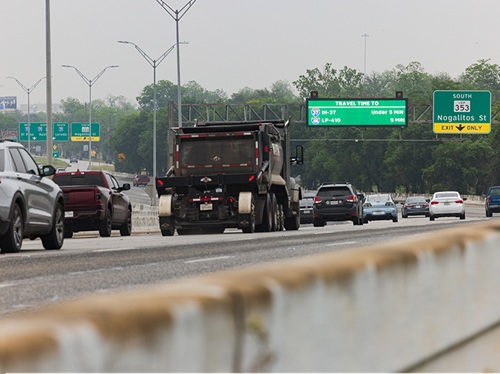
The Texas Department of Transportation and the Oklahoma Department of Transportation recently unveiled a new bi-state data sharing agreement designed to enhance traffic operations, improve information flow to travelers, and strengthen coordination across state lines.
[Above photo by TxDOT]
Through this agreement, the agencies said they are sharing a comprehensive set of transportation data, including:
- Traffic camera status and imagery.
- Incident data such as crashes, stalled vehicles, and roadway hazards.
- Dynamic message sign or DMS status and messaging.
- Traffic flow data, including speed, volume, and lane-level conditions.
- Lane closures and work zone information.
- Travel time data.
- Environmental sensor data.
TxDOT and Oklahoma DOT added that this exchange is powered through a center-to-center or C2C data connection, allowing both agencies to integrate and visualize shared information within their respective traffic management systems.

[Editor’s note: At the American Association of State Highway and Transportation Officials 2025 Annual Meeting in Salt Lake City, a knowledge session detailed how such multistate highway corridor initiatives can improve safety, mobility, and resiliency across broad regions of the United States.]
In addition to current capabilities, both agencies said they are exploring future enhancements to expand the value of this data partnership, including:
- Truck parking availability information.
- Freight corridor restrictions and routing data.
- Special event traffic coordination.
- Emergency and evacuation route data.
“This partnership demonstrates what is possible when states work together to deliver better outcomes for the traveling public,” explained Marc Williams, TxDOT’s executive director – who also serves as AASHTO’s vice president – in a statement.

[Editor’s note: TxDOT is also currently developing a draft of its 2027 Unified Transportation Program or UTP that includes more than $95 billion for projects across the state over the next decade.]
“By sharing data across state lines, we are improving situational awareness, supporting faster response to incidents, and providing more reliable travel information,” he said.
“This collaboration lays the foundation for a more connected and resilient transportation network across our region,” added Tim Gatz, Oklahoma DOT executive director. “By aligning our systems and sharing critical data, we are better equipped to serve the public and respond to both everyday conditions and emergency situations.”
“This kind of real-time cross-state data integration which aligns masterfully with USDOT’s National Digital Corridors Initiative (DCI) is exactly the type of innovation needed to modernize our nation’s transportation systems,” noted Seval Oz, assistant secretary of research and technology for the U.S. Department of Transportation.
“By enabling seamless data exchange across state lines, Texas and Oklahoma are setting a strong example for how collaboration and technology can deliver smarter infrastructure and more consistent traveler experiences nationwide,” she said.
TxDOT and Oklahoma DOT noted that they implemented this agreement in time to support increased travel demand during the World Cup, demonstrating the ability of both agencies to rapidly deploy innovative solutions through coordinated effort.
 States
NCDOT Helps Donate Laptops to 700 State Residents
August 21, 2026 States
