National transportation research nonprofit TRIP recently issued a new report that highlights the benefits and the needs of the U.S. Interstate Highway System or IHS, which is now reaching 70 years in age.
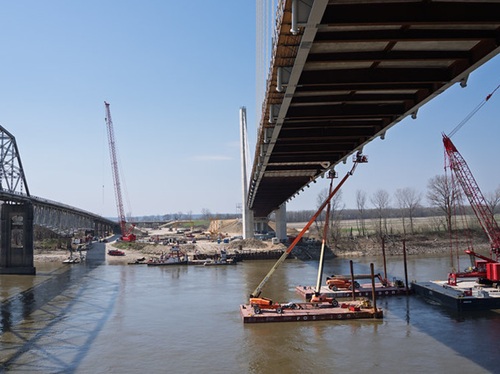
[Above photo by MoDOT]
TRIP’s new report – entitled Saving Lives, Time and Money: Maintaining the Enduring Value of America’s Greatest Infrastructure Achievement, the Interstate Highway System at 70 – indicates that the IHS provides Americans with $65 billion in benefits annually due to better safety; improved access to jobs, schools, healthcare services, etc.; more reliable and faster travel; and lower traffic congestion, which reduces vehicle fuel consumption, in comparison to non-interstate roadways.
The group’s research – which also incorporated findings from a 2018 report compiled by the Transportation Research Board – indicates that travel on the IHS is more than twice as safe as on all other roadways, a result of built-in safety features like median barriers, paved shoulders, a minimum of four lanes, and complete separation from cross traffic and rail lines.
Additionally, TRIP calculated a fatality rate of 0.57 per 100 million vehicle miles of travel or VMT on the IHS in 2024, compared to 1.39 per 100 million VMT on non-Interstate routes.
Furthermore, based on analysis from the Texas Transportation Institute at Texas A & M University, TRIP estimates that the IHS annually reduces total vehicle delays by 1.3 billion hours and reduces gasoline consumption by 369 million gallons compared to non-Interstate roadways.
“The Interstate Highway System at 70 continues to provide tremendous benefits to Americans, saving lives, time, and money,” said Dave Kearby, TRIP’s executive director, in a statement. “It is absolutely vital that we preserve these transportation benefits for future generations of Americans, but this will require that the funding needed to rebuild and modernize our interstate highways is provided.”
However, the organization’s report also noted that the IHS is carrying significantly higher levels of travel – particularly by large trucks – and lacks adequate funding to make needed repairs and improvements.

TRIP’s report found that from 2000 to 2024 overall vehicle travel on the IHS increased by 29 percent – a rate nearly triple that at which new lane capacity was added. As a result, 49 percent of urban interstates are considered congested during peak hours, the group said.
“As we all know, a safe, interconnected, well-maintained, and efficiently operated national transportation network is essential to our nation’s security and economy [and] the Interstate Highway System plays a pivotal role within that network, moving people and freight alike to their destinations safely,” said Jim Tymon, executive director of the American Association of State Highway and Transportation Officials.
“As we look to a federal surface transportation reauthorization, this TRIP report allows us to see just how important it is to invest in our Interstate system and give states the tools they need to ensure safe and efficient transport today and well into the future,” he added.
TRIP’s report also found that tractor trailer volume on Interstates increased at a rate more than double that of overall vehicle travel between 2000 and 2024; increasing 61 percent from 2000 to 2024, while overall vehicle travel increased by 29 percent.
The American Trucking Associations added that, while Interstates comprise just one percent of total U.S. road-miles, they carry 43 percent of U.S. truck traffic and that highway congestion costs the trucking industry $109 billion a year in delays and extra fuel costs.
“A system designed 70 years ago can no longer support the demands of the 21st century,” stressed Chris Spear, ATA’s president and CEO. “It is time … to invest in an Interstate Highway System that meets the needs of the next seven decades and beyond.”
TRIP’s report provides a set of recommendations for the restoration of the IHS; recommendations that mirror those offered by TRB in its highway system report eight years ago.
Those recommendations include: the foundational reconstruction of Interstate highways, bridges, and interchanges; improvement to roadway safety features; system right-sizing, including upgrading of some roadway corridors to Interstate standards; adding highway capacity on existing routes; adding more corridors; and modifying some urban segments to maintain connectivity while remediating economic and social disruption.