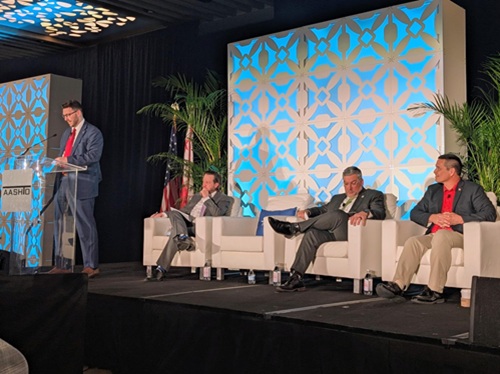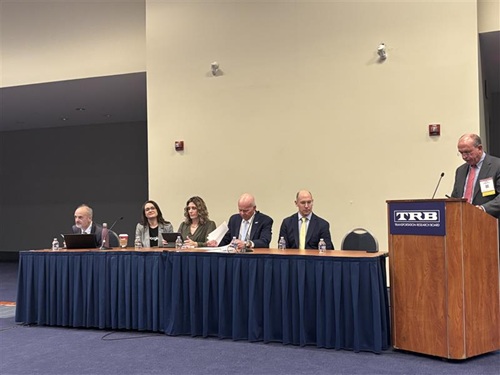
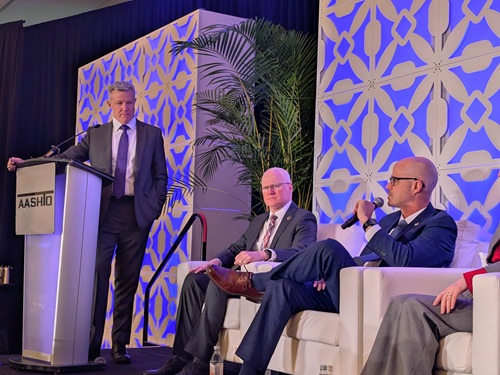
A panel discussion held at the 2026 Transportation Research Board Annual Meeting in Washington, D.C., examined the exciting future of deploying intelligent operations and management as well as other emerging technologies across the United States and beyond.
[Above photo by AASHTO]
Entitled “State-of-the-Art and Future Directions for Intelligent Operations and Management,” the session featured top leaders from the public and private sectors discussing how information technology and systems continue to provide major improvements to the U.S. transportation network.
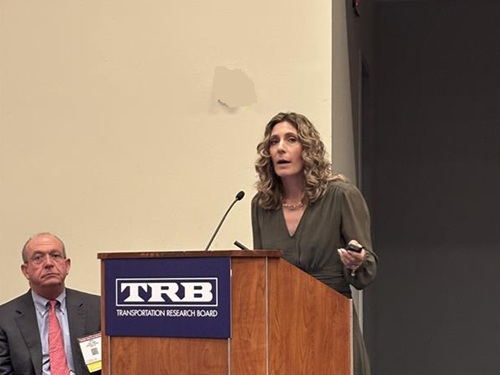
Laura Chace, president and CEO of the Intelligent Transportation Society of America, posed the question, “What would a day without technology look like?” to help frame the panel’s conversation around how technology plays an increasingly large role in moving both people and goods where they need to go.
From vehicle-to-everything (V2X) technology that allows cars to communicate with their surroundings to transforming roads, rails, and other modes into intelligent transportation systems (ITS) that transmit critical data in real time, the session focused on how states can keep pace with a such continuously evolving technological terrain. “We know that smart, scalable technologies help us close these gaps,” she said.
Carlos Braceras – executive director of the Utah Department of Transportation and a past president of the American Association of State Highway and Transportation Officials – explained how state departments of transportation are adapting to this ever-changing digital landscape.
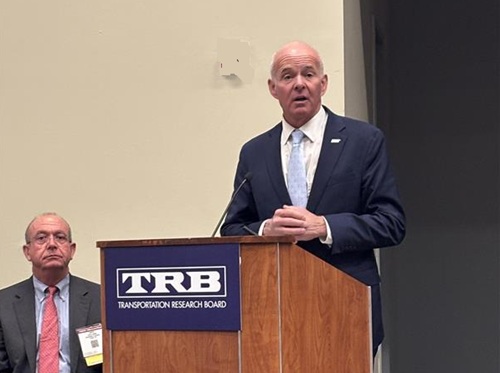
He highlighted how states are joining forces to identify and implement ITS best practices; pointing to AASHTO’s Committee on Transportation System Operations (CTSO) – a community focused on transportation system operations, ITS, and emerging technologies – as a key forum for advancing safety, system reliability, and highway performance.
“From the AASHTO perspective, the CTSO has a number of subcommittees that meet regionally” to delve into new transportation technologies, Braceras said.
He also discussed AASHTO’s development of “tiered leadership programs” and practitioner workshops that promote intelligent operations as well as a white paper on artificial intelligence that tracks how states are moving forward with this technology.
In Utah, Braceras pointed out how full real-time situational awareness has become a top item for his agency. From implementing a new ITS system to using Light Detection and Ranging or LiDAR technology at intersections, he emphasized how technological advancements are making a huge difference in his state.
Showcasing technological advancements on a national scale, Brian Cronin – director of the Intelligent Transportation Systems Joint Program Office at the Federal Highway Administration – highlighted how V2X technology is emerging as “a real gamechanger,” evolving from pilot programs to full operational deployments in various parts the country.
He added that his team is launching “a brand-new AI research program” with a focus on how this technology can help create “a safer, more efficient, productive, and resilient” national transportation system.
Angelos Amditis – chairman of the European Road Transport Telematics Implementation Coordination Organization or ERTICO – provided a global perspective on how AI is “anticipated to revolutionize and redefine mobility.”
Looking to work with transportation partners in the U.S. and beyond on AI and other emerging technologies, he called for “collaboration, open dialogue, and open borders.”
Kristin White – head of transportation strategy and partnerships at Google and former acting administrator of the FHWA – equated this new transportation technological era to the efforts behind the “moonshot” on the 1960s, noting that it took eight years to land a human on the moon and that transportation is due for a similar “next leap” forward.
“It all starts with, what is your mission? When you have a moonshot, what is your mission?” said White.
Highlighting the need for more human-centric storytelling, White gave a call to action to build relationships and make connections as transportation pivots to its next big-ticket item. “Ask yourself, what is your transportation story? For your personal values will champion this vision,” she stressed.
 Top Stories