


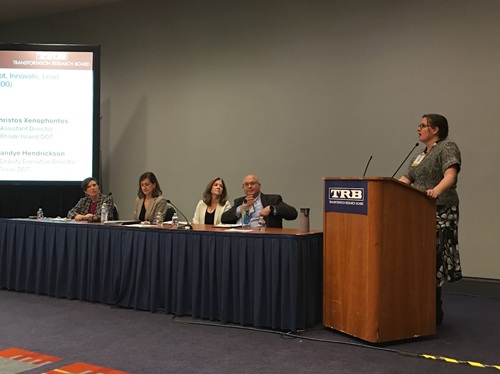
At the 2026 Transportation Research Board Annual Meeting in Washington, D.C., several state department of transportation executives shared their thoughts on how agencies can create a “blueprint” to help guide their efforts to adapt and innovate in order to successfully address a host of transportation challenges.
[Above photo by AASHTO]
“Innovation is who we are – it is a core value,” explained Nancy Daubenberger, commissioner of the Minnesota Department of Transportation. “We leverage it in every aspect of our work. That is what keeps us moving forward and guides how we respond to complex challenges.”
She noted that areas where innovation and technology align in MnDOT’s work include the use of recycled materials in infrastructure construction, autonomous vehicle testing in cold weather, using drones for bridge inspections, and equipping snowplows technology to more efficiently apply salt and balance brine application to roadways during winter operations.
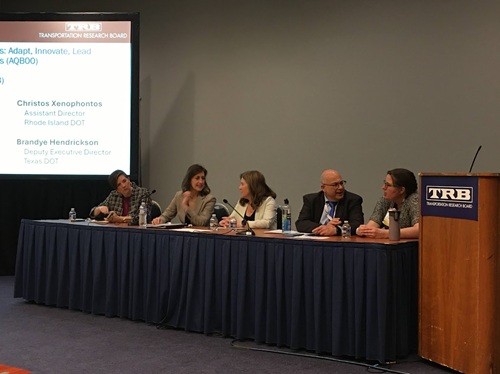
Digital project delivery is another area of innovation MnDOT is investing in. “That helps us increase efficiency and reduce cost, while improving management of agency resources,” Daubenberger added. “And it’s not about headline breaking news – it is about making small improvements that add up to larger savings.”
Audra Merrick, state engineer and deputy director of Arizona Department of Transportation, noted that investing in technology is also about the growing need to do more with less when it comes to project delivery.
“We want our projects to create opportunity and deliver value,” she said. “Transportation is more than getting people from one place to the next – it is about connecting people and strengthening the economy. But getting there takes work – and that is where the power of leveraging new technology comes in. As a government agency, we look at how we can create efficiency, value, and collaboration with technology.”
Christos Xenophontos, assistant director of the Rhode Island Department of Transportation, added that state DOTs need to be open to exploring new technologies to help them be more innovative and imaginative, but they must also revise their approach to risk-taking as part of that process.
“We need to take a constructive approach to failure; that is what will help us gain meaningful lessons for future progress,” he explained.
“It requires us to investigate how state DOTs must evolve to meet changing customer needs – and leveraging technology to do that. It does not happen overnight,” Xenophontos pointed out. “But a first step is to stop defining our work by assets but rather by the service delivered to the customer – and how it meets customer needs and expectations. Achieving that requires flexibility and agility on our part to respond to evolving demands; that means being comfortable with uncertainty.”
Brandye Hendrickson, deputy executive director of the Texas Department of Transportation, noted that “uncertainty” also means adapting to the incredibly fast pace of change occurring in the technology space – especially where artificial intelligence or AI is concerned.
“We rolled out an AI plan a year and half ago – and it is already outdated,” she said. “We just released updates to our AI plan and that is probably outdated now, as well. But we need to have such a plan in place because we must make sure we are setting expectations for AI – making sure we are operationally ready to use it, how we can leverage it across the department, plus measure the cost-benefit and other values it delivers.”
 Nation
Registration Open for AASHTO 2026 Spring Meeting
March 13, 2026 Nation
