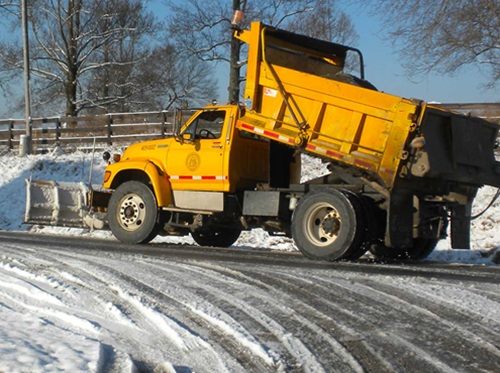
Across the country, state departments of transportation are using a variety of methods to prepare for winter operations – from providing special training for snowplow crews to deploying new de-icing materials and planning technologies.
[Above photo by the Georgia DOT]
For example, the Georgia Department of Transportation noted in a recent blog post that its brand new “Snow School” gave the agency an advantage as it prepped for winter operations this year.
Established in the wake of severe winter storms that struck the Peach Tree state in January, Georgia DOT said its Snow School provided standardized winter weather training for all seven of its districts.
Inspired by and made possible with the assistance of Indiana Department of Transportation – which provided some of that agency’s Snow School curriculum – Georgia DOT held its first-ever Snow School sessions in October and November.
“We wanted to make sure we are imparting the same standardized information and organizational knowledge we lose as people retire and move on,” noted Emily Fish, Georgia DOT’s assistant state maintenance engineer in emergency operations.
“Snow School covers topics like the proper brine salinity, the salt to rock ratio we put on the roads, and the proper techniques used to brine and plow roadways,” she said. “It also provides our districts with practical classroom and field training for dealing with winter weather conditions.”
While Georgia DOT’s districts were already providing training sessions like that, Fish said her agency wanted to make a broader snowfighting curriculum available to them every year so they have another tool in their toolbelt when dealing with winter weather.
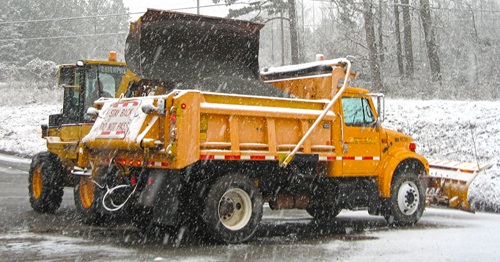
Meanwhile, the Wyoming Department of Transportation spent the fall getting its customized snowplows ready for extended winter work. In a recent video, the agency related how it prepares its 28-ton plow trucks for the winter – attaching the front plow, wing plow, and loading the sanding equipment in the back; a process that takes 30 minutes per vehicle.
The agency added that its snowplow drivers work in teams of two, with each handling a 12-hour shift. “So, when one guy gets done with the plow, another guy climbs in,” explained Brian Erickson, WYDOT maintenance supervisor, in the video. “And when we’re done with the storm, we’ll clean them up, wash them up, and inspect them – scheduling them with the mechanics if need be, if there’s any fixes that need to be done.”
New materials and technologies are also being deployed by some state DOTs to increase the capabilities of their snowfighting crews.
For example, the Kentucky Transportation Cabinet is using a new de-icing agent – an agricultural byproduct containing a small percentage of desugared beet juice – will be mixed with salt to increase its effectiveness when temperatures drop below 25 degrees; the threshold at which brine is not recommended.
KYTC said that this additive is safe for the environment and vehicles; adding that it also has stocked up 258,000 tons of salt, more than 1 million gallons of brine (salt/water mixture) to pre-treat roads, and more than 1 million gallons of calcium chloride (added to salt) as it finalizes its plan for keeping the 28,000 miles of road it’s responsible for clear of snow and ice this winter season.
Currently, to further strengthen statewide preparedness, KYTC is installing Roadway Weather Information System cameras to capture roadway images and weather data in real time. The compact, solar-powered devices are installed on existing infrastructure, such as light poles and traffic signals, to help officials monitor pavement conditions and make road-clearing decisions.
Forty-three of 50 cameras have already been installed, with this technology expected to help KYTC crews track storms, assess conditions in hard-to-reach areas, and make data-informed decisions for treatment, maintenance and emergency response.
“From the first flurries to the harshest storms, our team is on high alert to act when and where needed to maintain critical access for Kentuckians,” said Jim Gray, KYTC’s secretary, in a statement. “New cameras and road clearing materials are giving us both real-time visibility and new options to be more equipped than ever before to keep Kentuckians and crews safer.”
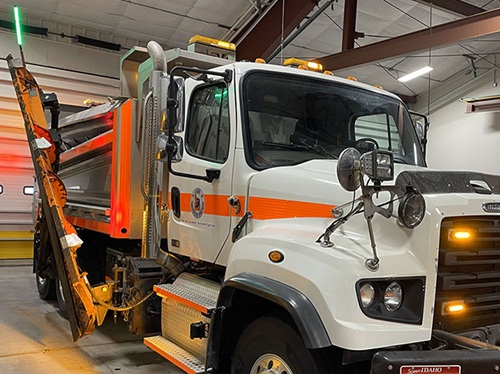
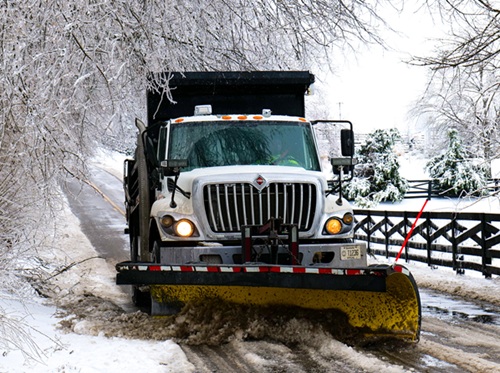
Out west, the Idaho Transportation Department is installing and testing upgraded new lighting packages this winter for its snowplows that feature:
- Two higher-mounted over-cab strobe lights.
- Four larger, sturdier wing lights mounted atop and at the side of the wing blade itself.
- Six total lights at the back of the truck, both strobing and alternating.
- New reflective orange and yellow checkerboard striping at the back of the plow truck.
- A whip-style, green rod light that extends six inches high at the edge of the wing plow.
Ty Winther, ITD’s operations manager, said the “green whip light” design has seen success in other states around the country and represents a “significant change” for his agency’s snowfighting equipment.
“Yes, green means ‘go,’ but it also gets your attention,” he said in a statement. “And, ultimately, that’s what we’re trying to do, what it’s all about – grabbing people’s attention.”
ITD noted that all of this trial lighting – chosen and installed by the agency’s plow operators, mechanics, and welders – will be placed on newer plow trucks as a standard across Idaho if they are found to be more effective at preventing snowplow strikes and increasing visibility for road workers year-round.