


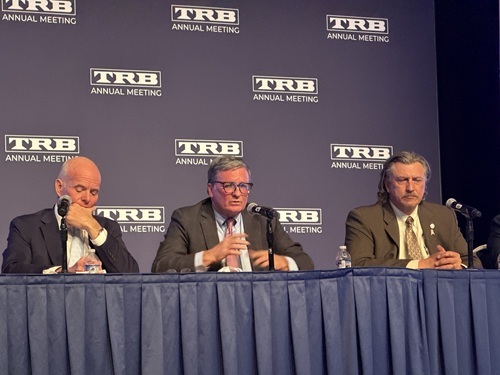
A roundtable session at the 2026 Transportation Research Board Annual Meeting in Washington, D.C., featured a cross section of state department of transportation chief executives discussing some of critical factors involved in the delivery of so-called “megaprojects” – large-scale and often multi-jurisdictional infrastructure endeavors that redefine mobility in a region, reshape economies, and leave a physical legacy that can last for decades.
[Above photo by AASHTO]
Marc Williams – executive director of the Texas Department of Transportation and the 2025-2026 vice president of the American Association of State Highway and Transportation Officials – moderated a panel that addressed the “exceptional political, financial, environmental, and certainly media scrutiny” that can come with such megaprojects.
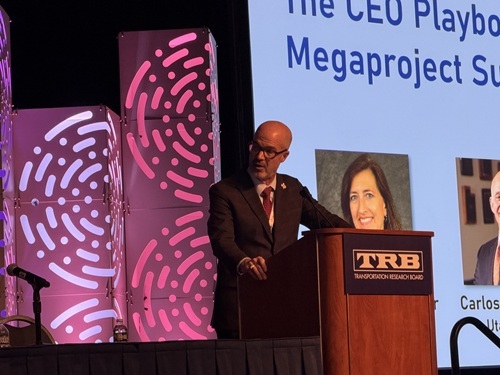
“Delivering them successfully requires not just engineering excellence, but leadership, discipline, risk, and the ability to communicate a compelling vision of the project’s benefits across the country,” he explained. “State DOTs are advancing some of the most ambitious projects in their histories. These projects are larger, more complex, more interdependent than ever before – often expanding community expectations and requiring sophisticated financing structures.”
As an example, Nancy Daubenberger – commissioner of the Minnesota Department of Transportation – referenced the massive $1.8 billion Blatnik Bridge project, which will replace the original structure built in 1961 with a new design that will not only handle higher volumes of motor vehicle and freight traffic but more safely accommodate bicyclists and pedestrians as well.
“It’s going to be out there for 100 years and so we needed to provide flexibility for other things in the future,” she explained. “One thing we did was … show how the addition of bicycling and walking access [on the bridge] improved connections to jobs and housing; that was key to gain support for decision to add those accommodations.”
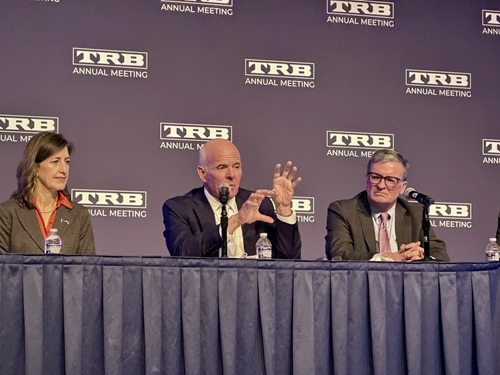
She added that Minnesota state agency leaders meet with Wisconsin agency leaders regularly to talk through the progress of the project – what some of the current challenges are, the timeline, and is it staying on schedule, for example.
“That’s really been key, especially when it comes to permits,” Daubenberger said. “It’s really been helpful to have leaders plugged in. We’ve also been very clear this is not just a MnDOT project. This is a Minnesota and Wisconsin project – and we’ve had the support of our governor’s offices to consider this a priority and something we need to make sure we’re keeping on track.”
Carlos Braceras, executive director of the Utah Department of Transportation, stressed that it is important to recognize that when a state DOT commits to building a big transportation project, “trust in you – your currency – is riding on this. This project puts you on a stage and everyone’s watching you. So, you have to make sure that you pick the right project and that you match up the project goals with the project’s risks.”
This is where it is critical to spend time understanding risk, he said. “That’s why you need to be the ultimate communicator – both internally and externally – about a project,” Braceras noted. “You must build partnerships with your legislature, with your local elected officials, with your contractors, with your consultants, and your suppliers. Because things are going to mess up; things are not going to go according to plan. That’s why you need to be the consummate communicator throughout the process.”
Yet he also emphasized that – at the end of the day – it is not the scale of the transportation project that matters, but what it delivers to the end user.

“I think we all recognize that the purpose of transportation is move people and the things that people need and to do so safely,” he explained. “We, the state DOTs, maintain that system, we operate the system, and then we deliver projects for the system – and it is really those three things that create the outcomes that the public expects.”
Mike Carroll, secretary of the Pennsylvania Department of Transportation, added that the multi-year nature of megaprojects also means they occur across changes in state government leadership – continuing regardless of who is in or out of office.
“You have a project that’s either under design, under construction, or in some stage of delivery when you become a secretary – and you don’t have much of a choice with respect to the steering of that project,” he pointed out. “That decision was made long before you inherited the position that you have. They are [often] legislative decisions made as part of [state] transportation funding.”
But that fact does not remove the responsibility for seeing the project through to completion – despite any unexpected “bumps in the road” that may occur.
“When you do have that, you have to be straightforward for folks and explain why there’s a delay in the project – why this is going to take a detour – with respect to the delivery of the project,” Carroll said. “You do not pitch a shutout when it comes to convincing the public that this is a good idea. But, you know, I’ll take 80 percent or 85 percent when I can get it. Sometimes you have to settle for 60 percent. But the point is, you have to do your best to communicate. You have to be forward and transparent with everybody.”
“You know, the one thing I’d tell you is, whatever ‘megaproject’ means to you as a state DOT CEO, the one thing I will assure you of is there’s nothing comfortable about it,” noted Tim Gatz, executive director of the Oklahoma Department of Transportation.
“That’s why communication and trust is so important – especially when it comes to trusting your people,” he explained. “That’s why your team is so important. Trust in the people that you’ve got around you to advance it. Put the right people at the table with you, create the right plan, and then make the decision to go forward.”
Will Reid, commissioner of the Tennessee Department of Transportation, emphasized there is one certainty about megaprojects that will hold true in the future: There will be many more of them.
“I think these megaprojects are going to become more and more prevalent just by the nature of the growth that we see in certain parts of the country,” he said. “You need these big solutions that are going to be able to drive significant impact when it comes to managing the transportation system.”
And, from where he sits, that is why communication will become a far more critical factor in such infrastructure endeavors in the years ahead.
“We oftentimes, fairly or not, are judged as state DOTs on how we perform on these megaprojects. So, it’s very important that we are transparent and we put the information we have out there,” he emphasized.
“Because, frankly, trust in us comes from being able to deliver projects on time,” Reid said. “So, when it comes to communicating from the state DOT standpoint, stick to the facts and meet people where they are when it comes to communicating with them so we can build trust in our ability to deliver projects on time. And that’s really what we’re about.”
 Top Stories
Congressional Leaders Detail Key Transportation Priorities
February 27, 2026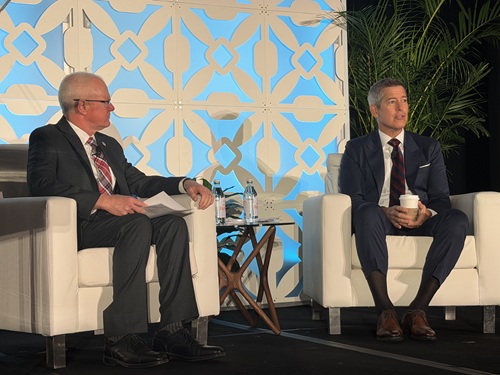 Top Stories
