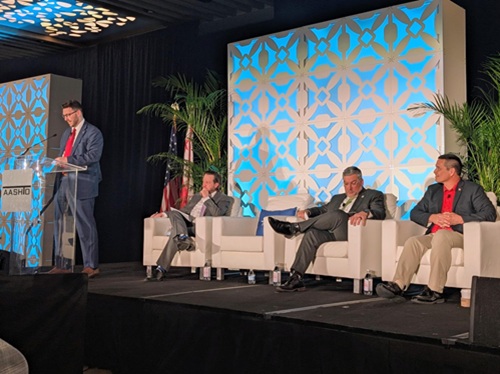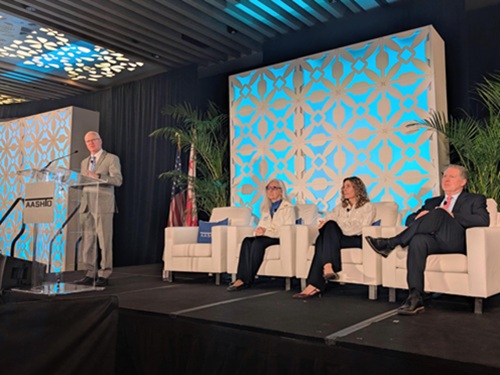
The American Association of State Highway and Transportation Officials recently hosted a knowledge session at its 2026 Washington Briefing in Washington, D.C., that focused on the emphasis areas of Russell McMurry, AASHTO’s 2025-2026 president.
[Above photo by AASHTO]
McMurry – commissioner of the Georgia Department of Transportation – moderated a panel that offered a broader transportation industry perspective on his emphasis areas, which focus on reauthorization of federal surface transportation funding, improving safety, and improving project delivery.
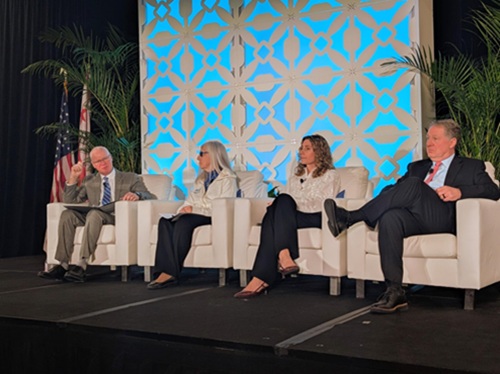
That panel featured Marsha Anderson Bomar, president of the American Society of Civil Engineers; Laura Chace, president and CEO of the Intelligent Transportation Society of America; and Jeffrey Shoaf, CEO of the Associated General Contractors of America.
“My emphasis areas call for a ‘back to basics’ approach to the upcoming surface transportation reauthorization bill; one that prioritizes robust federal funding, that improves safety outcomes, and – one of my favorite things – speeds up project delivery,” McMurry said during the session.
“[Reauthorization] legislation is a means to those ends; one that can deliver tangible outcome in the states,” he added. “Also, technology offers a real opportunity to improve our work flows here, so there is an opportunity to work technology into the reauthorization discussion.
ASCE’s Anderson Bomar stressed that “continuous, predictable, and reliable funding is critical to our work and the communities we serve” and that the infrastructure permitting process “is very convoluted.” To get more federal dollars working on infrastructure projects means the permitting process must be streamlined, she added, because “we don’t have a lot of time to waste for infrastructure improvements. That is why we are looking forward to working together on these issues.”
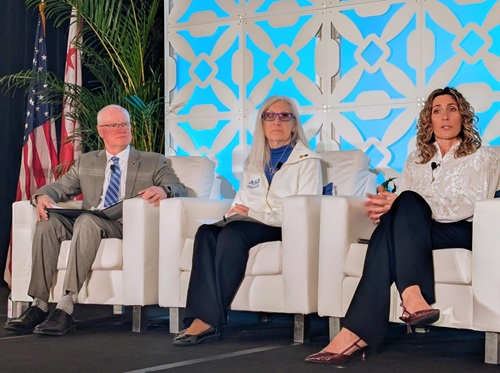
She added that transportation projects “are transformative – they touch a lot of lives” and so the industry needs “good storytellers” to convey the benefits of such projects not just to the public but to legislators as well.
“Some legislators can understand engineering, some do not, but all of them understand stories from the heart – how projects change the lives of people and their communities,” Bomar noted. “We need to be very effective at telling those stories.”
AGC’s Shoaf echoed Bomar’s perspective, adding that “the easiest thing to sell on Capitol Hill is program efficiency.”
He also pointed out that “making road improvements matter to their [legislators’] constituents and to their neighborhoods. We also must make sure they see the statistics that add up to that story – to give them a reason to get out there and lead.”
ITS America’s Chace noted that while her association is also “calling for a robust reauthorization bill, because roads and bridges are the backbone of our physical transportation network,” that bill should also offer expanded support for the digital needs of that network.
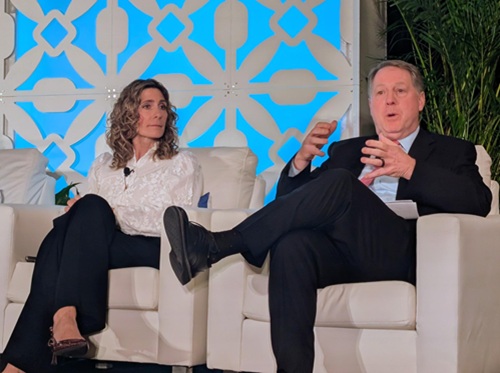
“We can do both things at the same time – improve both our physical and digital transportation infrastructure,” she said.
Chace also noted that focusing on the digital aspects of the transportation system via reauthorization opens up the potential for major safety gains as well.
“There are so many opportunities out there, with real-time crash avoidance data creating an additional safety layer for users,” she explained. “The reauthorization bill offer more opportunities for things like that.”
AGC’s Shoaf agreed with that safety perspective as well. “There’s a big opportunity to improve behavioral safety” with the reauthorization bill, he said.
“We need to teach drivers about highway work zone safety – and teach that during their initial training,” Shoaf stressed. “Additionally, we’ve seen that speed camera systems are knocking down the occurrence of cars speeding in highway work zones. That’s vital as we need to protect our workers on the roadway.”
 Top Stories