


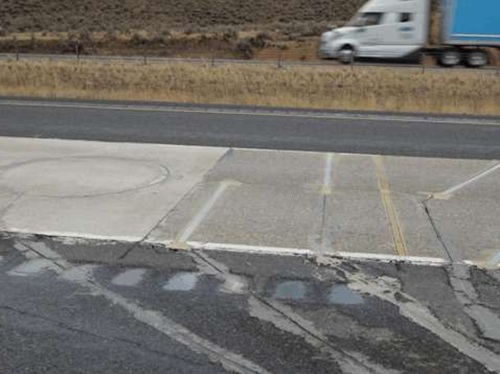
The Utah Department of Transportation has deployed new technology at the state’s ports of entry to spot tire problems on freight and transport trucks before they lead to dangerous failures on highways statewide.
[Above photo by Utah DOT]
The agency said this technology, called an “in-road tire anomaly detector,” uses embedded sensors paired with screening software. As trucks roll over the sensors at a port of entry, the system measures each tire and sends that data to connected programs that create a digital image of the tire.
The software then runs that image through a series of programmed tests, supported by artificial intelligence, to identify any abnormalities – and if the system flags an irregularity, a port of entry inspector performs a hands-on inspection to determine the severity of the issue and how it should be mitigated.
The technology is currently in use at the Perry, Peerless, Wendover, Echo, St. George, and Monticello ports of entry, with installations planned next for the Daniels and Kanab ports. The agency noted that its long-term goal is to equip all eight Utah DOT-operated ports with this detection system.
Utah DOT added that while commercial drivers are required to make daily pre-trip checks that include the condition of their truck and/or trailer tires, out on the road, tire conditions can change instantly.

“When a tire fails on the road, the consequences can be serious, both for truck drivers and for everyone sharing the highway,” explained Cheyenne Enns, Utah DOT’s Echo Port of Entry agent, in a statement. “This technology helps us catch problems early before a truck ever leaves the port. It’s another way we’re preventing crashes, protecting drivers, and keeping Utah’s roads safer for everyone.”
She noted that the state’s commercial vehicle inspectors are constantly watching for flat, threadbare, or damaged tires – but stopping every vehicle to manually inspect as many as six to 42 tires on a double-belly truck isn’t always feasible. Consequently, the software-based anomaly detection system speeds up the process and gives inspectors valuable time back to focus on other responsibilities.
“The dangers of tire failures can be anything from a minor inconvenience to something that can be deadly,” added Howard Trexler, Utah DOT’s motor carrier senior business analyst.
“Beyond the potential for the loss of life, tire failures can result in damaged roads, increased taxpayer dollars spent on litter cleanup or maintenance, and they disrupt our truckers’ important routes,” he pointed out. “This new system is improving mobility, health and economy for everyone in Utah.”
 States
Rodrigue Confirmed as New Hampshire DOT Commissioner
March 6, 2026 States
