


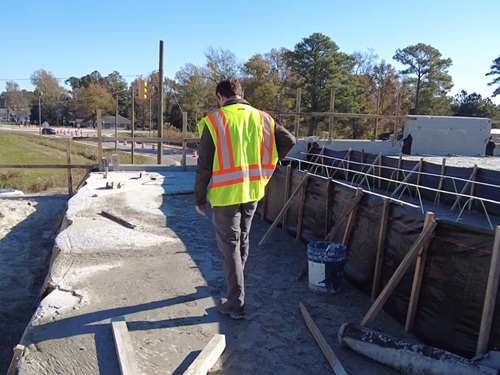
The North Carolina Department of Transportation is using a new form of concrete as part of project elevating a section of U.S. 70 where it will connect with the soon-to-built I-42 highway at five new interchanges.
[Above photo by NCDOT]
NCDOT noted that the location of the future I-42 in James City presented unique challenges due to soil conditions, which made traditional fill materials less viable.
The agency’s construction team looked at several options for building on the existing highway footprint and concluded lightweight cellular concrete – created from a mix of cement, water, and a foaming agent – would be the best material for the job.
“With a traditional fill material that the department would use, we would have 280 days just in settlement time,” noted Wendi Johnson, NCDOT’s resident engineer for this project, in a statement. “This lightweight cellular concrete that we’re using actually reduces the settlement to about 90 days.”
NCDOT added that two of the five interchanges between U.S. 70 and the future I-42 are currently under construction, with a final project completion date expected in 2028.
Many state departments of transportation use non-traditional materials in a variety of infrastructure projects to address unusual needs.
For example, the New York State Department of Transportation recently completed a $25 million project in Westchester County that elevated a flood-prone roadway corridor through the use geosynthetic reinforced soil technology, foamed glass, organic material, fabrics, grids, and meshes to strengthen the embankments and hold soil in place.
Foamed glass is lightweight, durable, fireproof, and waterproof, NYSDOT noted, and is manufactured by heating a mixture of crushed glass with foaming agents, which release carbon dioxide, sealing the air cells in the glass and giving the material its durability. Using that material also helped shave a year off the project’s total completion time, the agency said.
Foamed glass also has been used by other state DOTs in road construction and other applications. In 2024, the Arizona Department of Transportation used foamed glass to strengthen interstate culverts on I-17, while in 2025, the Wyoming Department of Transportation used it to rebuild a 100-foot embankment lost in a landslide along Teton Pass highway near the Grand Teton National Park.
 Top Stories
Western State DOT Projects Win Regional Awards
July 24, 2026 Top Stories
