


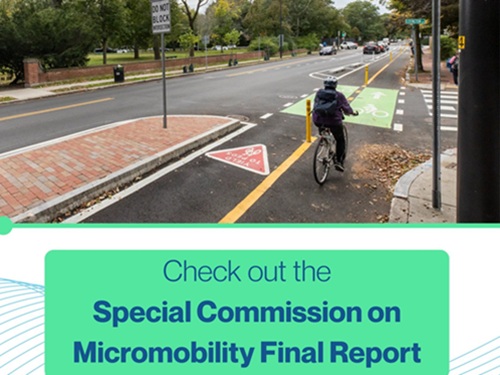
The Massachusetts Department of Transportation said its Special Commission on Micromobility – established by the state legislature as part of the economic development bill, the Mass Leads Act – recently issued a final report that offers recommendations for expanding micromobility options statewide.
[Above image by MassDOT]
The agency noted that “micromobility vehicles” include bicycles, electric-power bikes or e-bikes, scooters, e-scooters, skateboards, and other small personal travel devices.
“Micromobility device use has grown and offers alternative transit solutions,” noted Phil Eng, interim MassDOT secretary and general manager of the Massachusetts Bay Transportation Authority, in a statement.
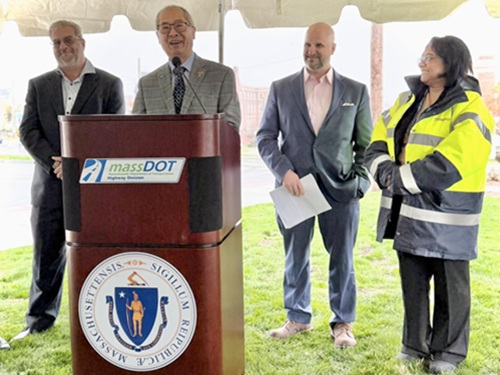
He said that the Special Commission on Micromobility’s recommendations will be used as a resource for future legislation, regulations, and program development to support safety and encourage growth and expansion of micromobility.
“[The commission’s report] builds upon our efforts to strengthen safety across all mode to deliver that well balanced transportation network that the public deserves and expects,” Eng explained. “We are optimistic that these recommendations will lead to a safe and well-regulated adoption of micromobility devices.”
“Safety is our number one priority at MassDOT and the recommendations of the Special Commission on Micromobility will ensure that future growth of micromobility devices focuses on safety for all road users,” added Jonathan Gulliver, the agency’s undersecretary and state highway administrator.
“Through close cooperation with our highway safety team, the Special Commission on Micromobility recommends amendment to state law to include all types of micromobility incidents in MassDOT crash statistics, an improvement which would give our planners and project designers essential data to make decisions on safety and operational improvements,” he said.
Many state departments of transportation are engaged in concerted to support micromobility and micromobility-related transport options in their respective regions of the country.
For example, the New York State Department of Transportation recently launched a comprehensive study aimed at improving regional transit coordination in the Hudson Valley for commuters living west of the Hudson River – a study that includes active transportation connections to those transit services.
The agency said its West of Hudson Transit Study will address significant transit issues and enhance rider experiences in underserved communities, focusing on bus service improvements and connections to existing rail lines and ferries.
Meanwhile, the South Dakota Department of Transportation will be funding 16 recently-approved sidewalk, trail, and shared use path projects across the state.
And the North Carolina Department of Transportation recently began accepting applications for the 2026 award round from its Multimodal Planning Grant Program, which provides state planning funds for identifying bike and walking paths and transit connections.
Multimodal planning helps communities grow with transportation systems that are safer, more connected, and accessible for all users, NCDOT said – whether by driving, walking, biking, or using transit.
 States
Rodrigue Confirmed as New Hampshire DOT Commissioner
March 6, 2026 States
